Updated: April 2026
From the outside looking in, building a dating app looks simple. The market is massive; everyone seems to be single and ready to mingle. It doesn’t help that Tinder and Bumble make it feel like there is still room for the next breakout platform. But the reality is, this is one of the hardest categories to win in.
The difficulty of a dating app isn’t the technology. The challenge is user behavior. Most dating apps fail for the same reasons:
- They cannot get enough users at the same time
- They fail to keep people engaged
- They never figure out how to monetize without hurting the experience.
Investors are well-aware of these difficulties. Because of this, when they look at a dating app business plan, they aren’t asking, “Is this a good idea?” Instead, they are asking, “Why will this succeed where thousands of others failed?” That is a much higher bar.
The goal of this guide isn’t to explain what a business plan is. It’s to show you how to think through a dating app startup the way an investor would:
- How you solve the cold start problem
- How you drive retention, not just downloads
- How your model actually makes money
- Where most founders get it completely wrong.
In the dating space, a polished plan is not enough. If your strategy doesn’t hold up under real-world dynamics, it will break quickly. Your business plan will expose that.
If you want to create a plan that investors don’t ignore, you need a structure that forces you to answer the hard questions early; before the market does it for you.
Note: Before creating a business plan, it’s important to know the ins-and-outs of launching a dating app startup. Learn what it takes to create a dating app that wins: How To Create A Dating App That Doesn’t Suck
What Is A Dating App Business Plan?
Definition (Investor-Focused)
A dating app business plan is a structured document that explains how a dating platform will acquire users, retain engagement, and generate revenue within a highly competitive, network-driven market.
At its core, a dating app business plan must clearly define:
- Who the app is for and what specific problem it solves
- How users are acquired and brought onto the platform
- How engagement is sustained over time
- How and when the app generates revenue
- How the platform reaches and maintains critical user mass
Dating startup business plans aren’t just about the idea. These plans are about proving the mechanics of growth, engagement, and monetization actually work together.
How It Differs From Other Startup Business Plans
Most startup business plans focus on product, market size, and growth potential. In contrast, dating app business plans are driven by behavior and dynamics.
Key differences between dating app business plans and generic ones include:
- Network effects dominate everything: The value of your dating app depends on how many people are using it at the same time. Without enough active users, the product breaks.
- Retention matters more than acquisition: The challenge isn’t getting downloads. The difficulty is keeping users engaged long enough for the app to create value.
- Monetization is delayed and sensitive: You cannot push revenue too early without hurting user experience. However, waiting too long creates sustainability issues.
- Supply and demand must stay balanced: If one side of the platform outweighs the other, user experience declines quickly and churn increases.
Why This Definition Matters
Treating a dating app like a typical startup is a mistake. Doing so makes you focus too much on features and not enough on behavior. This is where most dating app business plans fail.
This is why structure matters. You are not just outlining a business. Instead, you are proving that the core engine of the app, including users engagement, and revenue, can actually function in the real world.
Why Most Dating App Business Plans Fail
Even great dating app ideas can fail in the fundraising process. Often, fundraising failure isn’t about bad ideas. These founders fail because the core mechanics of the business don’t meet investor criteria.
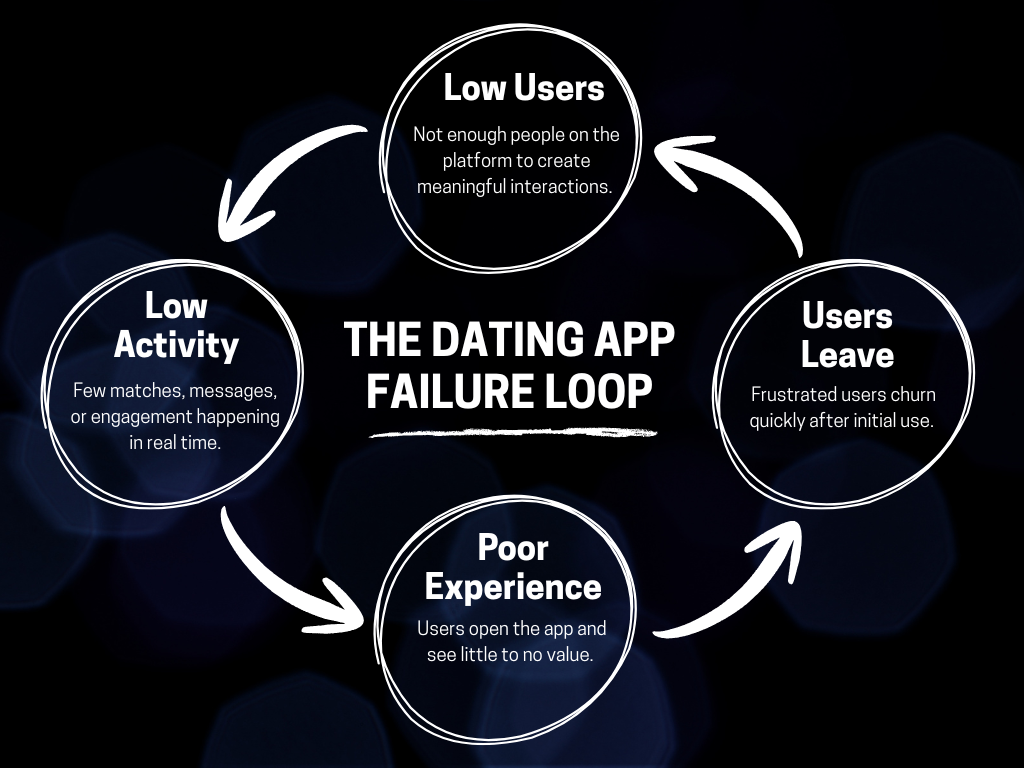
On paper, everything looks promising. They have a large market, strong demand, and a simple product. But when you break down how users actually behave, where growth comes from, and how money is made, the plan starts to fall apart. Investors notice this immediately.
No Clear Differentiation
I’ve reviewed over a hundred dating app business plans over the last several years. The truth is, most of them sound exactly the same:
- “Better matches.”
- “More meaningful connections.”
- “A new experience.”
These plans all had the same premise; the same wording. And none of them held up in front of real investors. If you app isn’t built around a clear and defensible advantage – like a specific audience, behavior, or mechanism – it gets grouped with every other dating app in the market. In a saturated space like dating apps, that is where ideas go to die.
Unrealistic User Growth Assumptions
Inexperienced founders wrongly believe that growth will come naturally. It doesn’t. Dating apps do not grow in a linear fashion. To succeed, they require:
- A critical mass of users
- Actively at the same time
- Enough engagement to create value
Without this combination, new users join, get bored quickly, leave, and never come back. If your plan does not explain how you reach initial liquidity, investors will drastically question your plan’s credibility.
Ignoring the Retention Problem
Most dating apps fail because they can’t retain users. Getting users is possible, keeping them is challenging. Users want to see new people joining constantly, they want an advantage in dating, and they want quick results. If they don’t get these things, they move on to the next dating app.
Your app will never stabilize if users don’t:
- Come back regularly
- Engage consistently
- Find ongoing value
Without that retention, everything else breaks:
- Network effects weaken
- Monetization becomes impossible
- Growth stalls
If retention is not a core part of your plan, the business will completely fall apart.
Weak or Undefined Monetization Logic
If you don’t understand monetization, you won’t convince investors that you do. Founders try to hide their lack of understanding through vague ideas like:
- “Premium features.”
- “We’ll add subscriptions later.”
- “We’lll sell ads at scale.”
That may work for some industries (personally, I can’t think of any), but in dating apps, monetization is delicate.
If you push too early, you kill the user’s experience. If you wait too long, the business can’t sustain itself. It’s a very fragile balance.
A strong plan clearly defines who pays, when they pay, and what incentives they have to upgrade. If these things aren’t explained well, investors will reject your startup. If you can’t make them understand how you make money, it’s impossible to show them how they’ll make money.
Why Dating Business Plans Get Ignored
The truth is, just because your business plan looks complete, doesn’t mean it is. Too many dating app founders focus on filling out sections instead of proving that they actually know how to win. Then, when they are pressure tested, they lack clarity in the exact areas that matter most.
Ultimately, this is why most dating app business plans fail.
What Investors Actually Look For In Dating Apps
To be honest, most investors have seen way too many dating apps. They aren’t impressed by the “next great dating app idea.” What they are actually evaluating is something much more specific: “Can this actually become a functioning scalable marketplace?” (Yes, a dating app is technically a marketplace)
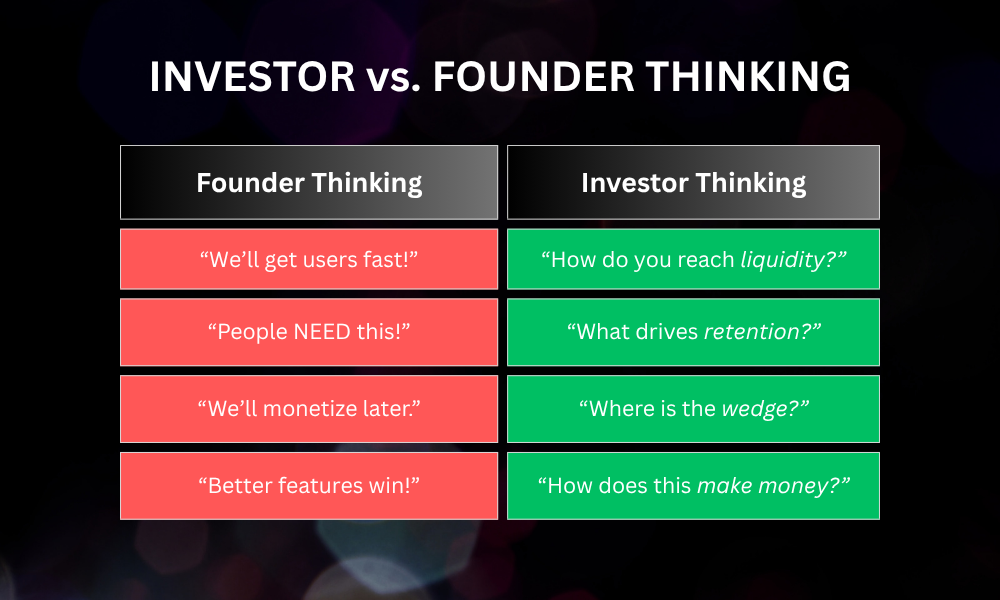
Let’s look at what investors actually look for when evaluating a dating app startup.
Proof You Can Reach Initial Liquidity
The first massive hurdle you will face when getting in front of investors is proving you can reach initial liquidity. A dating app only works if there are enough active users at the same time to create value. Without that, nothing else you write in your plan matters.
Investors want to see:
- A clear plan to acquire your first users
- A strategy to bring them on in a concentrated way
- Early signs that users will engage once they join
A Clear Retention Strategy
In the dating app sector, retention is the core of the business. Without retention, you don’t have a dating app; you have a “walking dead” solution. It may be showing some signs of life, but it’s a zombie.
Investors are asking:
- Why will users come back tomorrow?
- What keeps them engaged over time?
- What prevents churn after the first few uses?
The answer to these questions should go far beyond just the features you are offering. To make investors lean in, your business plan needs to show:
- Behavioral loops
- Ongoing value creation
- Reasons to return after initial matches
If you can’t clarify how you will retain users, growth and monetization are irrelevant.
A Defined Niche or Advantage
Here’s a hard truth – most dating apps have no chance of succeeding in today’s market. The “dating app” wave has already touched the shore, and only a select few still exist.
For a dating app to receive significant funding, the founders must meet investors’ criteria. Investors are looking for:
- A specific audience
- A clear use case
- A differentiated entry point into the market
These things create your wedge and advantage. Having a defined niche or wedge allows your startup to:
- Acquire users more efficiently
- Build early density
- Compete in a saturated space
If your plan targets “everyone,” it basically targets no one. It’s very unlikely you’ll win with another “general dating app.” The winners are those who find a niche that is underserved with high demand.
Real Monetization Logic
“Subscriptions” is not a strategy. Neither is “ads.” When reading a dating app business plan, investors want to understand:
- What users are paying for
- Why they are willing to pay
- When monetization is introduced
- How it impacts user expertise
The strongest dating app business plans show:
- Clear upgrade triggers
- Thoughtful pricing structure
- Alignment between value and payment
If monetization feels like an afterthought, you’re approaching this from the wrong end.
Understanding CAC vs. LTV
At some point, every business becomes a math problem. Investors want to see:
- How much it costs to acquire a user (CAC)
- How much that user generates over time (LTV)
- Whether the model becomes profitable at scale
Even early stage plans should show:
- Logical assumptions
- Awareness of cost structure
- A path toward sustainable economics
If your startup’s CAC exceeds LTV, you don’t have a viable business; you have a sinking ship.
Dating App Business Plan Structure
Despite how most founders approach a business plan, the goal isn’t to simply fill in every section.
Ultimately, the goal is to prove that your dating app can actually function in the real world, where user behavior, competition, and engagement determine whether the product lives or dies.
The sections presented below aren’t just areas for you to fill in information. Instead, think of each section as a test of whether your model actually holds up.
Executive Summary
The Executive Summary is often described as a “high-level overview.” It’s not. Actually, it’s a clear argument for why your app won’t become just another failed dating app in the software graveyard.
This section must quickly show:
- A distinct niche, wedge, or positioning
- A credible and believable path to traction
- A business model that makes sense
If this section feels generic, the rest of the plan is a waste of time – investors will give up on the plan before they even turn to the next page.
Common Mistake:
Founders describe what the app does instead of why it will succeed.
Problem & User Behavior
When describing a problem, it must be real and meaningful. “Dating is hard” is not a problem statement.
Your business plan needs to define:
- A specific frustration
- A clearly identified user segment
- How that segment currently behaves
The problem statement isn’t just about understanding pain points. Ultimately, it’s about understanding how your audience behaves.
Common Mistake:
Founders generalize the problem instead of anchoring it in real user patterns.
Solution
As mentioned, when you describe your solution, you must go beyond features. The Solution section needs to show:
- A unique mechanism (matching logic, niche focus, or experience design)
- Why users would choose this over existing options
- How it fits naturally into user behavior.
As investors evaluate your startup, they are asking: “Is this meaningfully different, or just slightly better?”
Common Mistake:
Founders build variations of existing apps without a defensible edge.
Market
Your market opportunity isn’t defined by how big dating is globally. In reality, it is about:
- Who you are targeting first
- How large that segment is
- Why you can realistically capture it
A fundable dating app business plan shows a niche market strategy, as opposed to mass-market ambition from day one.
Common Mistake:
Founders try to appeal to everyone instead of dominating a specific, niche segment.
Business Model
When it comes to your business model, clarity matters. You must clearly answer:
- Who pays?
- When do they pay?
- Why do they upgrade?
In dating apps, monetization is tied closely to user experience. If it is forced or unclear, it creates friction.
Common Mistake:
Founders assume monetization will “figure itself out later.” It won’t.
Go-To-Market
The go-to-market strategy is where the theoretical strategies you have mentioned meet reality. In this section, you need to show:
- How you acquire your first users
- How you bring them in with enough density to create value
- How you avoid an empty platform at launch
In other words, you must directly address how you will overcome the cold start problem.
Common Mistake:
Founders assume users will come without a structured launch strategy.
Network Effects Strategy
Network Effects is what makes or breaks a dating app. If you want investors to take you seriously, this section must show:
- How supply and demand are balanced
- How user activity increases platform value
- How engagement compounds over time
If your network effects strategy is unclear, the product will never be able to sustain itself.
Retention Strategy
Retention is the foundation of everything in the world of dating apps. In this section, you need to clearly explain:
- Why users return daily or weekly
- What keeps them engaged after initial use
- How the experience evolves over time
To address these considers, focus on:
- Engagement loops
- Behavioral triggers
- Ongoing value creation
Common Mistake:
Founders focus on acquisition and ignore what happens after signup.
Validation
The Validation section is where your idea becomes real. Ultimately, investors are looking for:
- Early traction
- Waitlists or signups
- Behavioral signals proving that users actually want this
Even small signals are important if they are real.
Common Mistake:
Founders present assumptions instead of evidence.
Financials + Funding
In the Financials section, you will tie everything together. You must show:
- How user growth translates into revenue
- When monetization begins
- How funding supports key milestones
Your numbers should reflect the realities of:
- Acquisition costs
- Retention rates
- Monetization timing
Common Mistake:
Founders present projections without grounding them in how the app actually grows.
Why This Structure Matters
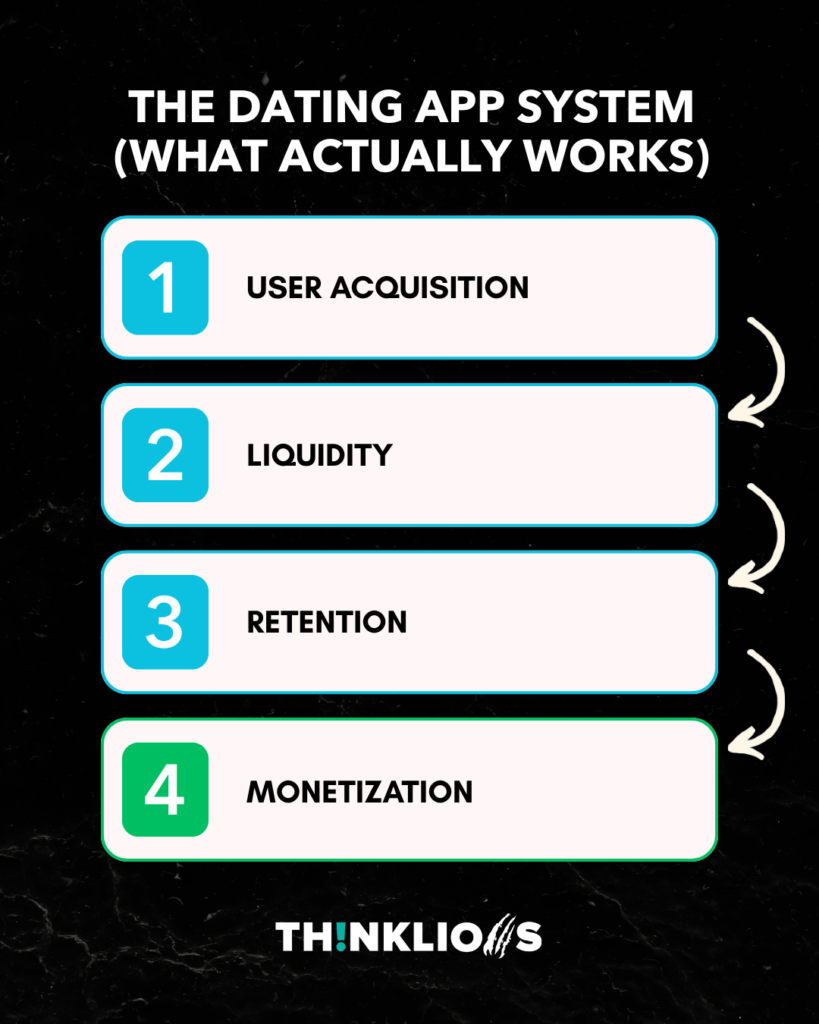
Investors aren’t judging your dating app business plan by how polished it looks. It is judged by how the system works:
- Users join
- Users stay
- Users engage
- The business generates revenue
If this system breaks at any point in the business plan, the entire model breaks with it.
Note: Business plans give investors a deep dive into your dating app business. However, pitch decks introduce your business to investors. Get inspired by some of the world’s best pitch decks: 40+ Best Pitch Decks We’ve Ever Seen
Building Your Plan The Right Way
At this point, you can see this is not something you want to piece together from scratch.
That is exactly why we built a structured system for this:
- Step-by-step guidance through each section
- Built specifically around network effects, retention, and monetization
- Designed to help you think like an investor, not just fill in a document
If you want to build something that actually works, instead of something that just looks complete, this gives you the structure to do it properly.
Dating App Startup Challenges
The dating app sector is full of great ideas that failed. Ideas are rarely the basis of fundraising or operational failure. These apps fail because founders underestimate the dynamics of the system they are trying to create.
The Cold Start Problem
One significant challenge for dating apps is that if there are no users, there is no value. If people join and don’t see activity, they leave immediately. That means you need density and momentum from day one. Slow, gradual growth can work for some startups, but it does not work for dating apps.
This is one of the hardest problems to solve. Yet, most dating app business plans completely ignore it.
Gender Imbalance Issues
Dating apps are marketplaces. If one side of the platform outweighs the other, the experience breaks. For most dating apps:
- Too many men leads to low response rates
- Too many women leads to low engagement quality
In marketplace apps, balance is essential to retention.
Retention Drop-Off
Most users churn quickly. They download the app, try it briefly, and leave if they don’t see immediate value.
If your product lacks incentive for users to return, it will never stabilize. Eventually, it will fizzle out like hundreds of dating apps before it.
Monetization Resistance
Users are sensitive to paying for apps in general. However, this is especially true with dating apps.
If you push too early, you hurt adoption. If you push too late, you will never build a sustainable business. Ultimately, you need a model that feels natural and enough value that users are willing to pay to access it.
Common Mistakes in Dating App Business Plans
Weak plans follow common patterns. They often look promising on the surface, but fall apart under basic scrutiny. The most common mistakes in dating app business plans include:
- “We’ll Go Viral” Thinking: Virality is not a strategy. Assuming users will spread your app without a structured acquisition plan is one of the fastest ways to fail.
- No Niche Focus: Trying to build for everyone leads to traction with no one. Strong apps start with a specific audience and expand from there.
- Ignoring Retention: Focusing on downloads instead of engagement. If users don’t come back, nothing else matters.
- No Monetization Clarity: Vague ideas like “premium features later” are not enough. You need to clearly define who pays, why they pay, and when they convert.
Should You Use A Dating App Business Plan Template?
General business plan templates usually aren’t sufficient for dating apps. Typically, they ignore the specific dynamics that actually determine success in this space.
Where Most Templates Fall Short
Most business plan templates don’t work dating apps because they:
- Focus on generic sections instead of system mechanics
- Ignore network effects entirely
- Do not address retention as a core driver
- Overlook liquidity and marketplace balance
They help you organize ideas, but not build a working model.
What A Strong Template Should Actually Do
A real dating app business plan template should:
- Force you to think through network effects and user flow
- Highlight retention as the core of the business
- Address the cold start and liquidity problem directly
- Guide how monetization fits into the user experience
It should act as a system, not a checklist.
The Difference Between Templates vs. A Structured System
We built our Dating App Business Plan Template around what founders in this space actually need, and what investors actually require. We call it a “template,” but in reality, it is a structured system for creating a winning dating app business plan. It is:
- Step-by-step and guided
- Designed specifically for dating platforms
- Built around how these businesses actually succeed or fail
Instead of asking what to write, it helps you understand whether your model actually works. And that is the difference between a plan that gets ignored and one that gets taken seriously.
Build A Plan Investors Trust
At this point, it should be clear: This is not about just writing a document.
It is about building a system that actually works:
- Users join
- Users stay
- Users engage
- The business generates revenue
Most founders try to piece this together manually. They follow generic templates, fill in sections, and assume the details will work themselves out later.
That is where things break. Because in dating apps, if the system is flawed:
- Growth stalls
- Retention collapses
- Monetization never materializes
And the business never gets off the ground.
Use a System Designed for This
- Step-by-step guidance through every section
- Built specifically for network effects, retention, and monetization
- Designed to help you think like an investor, not just complete a plan
- Structured to expose gaps before they become real problems
If you are serious about building a dating app that can actually scale, this gives you the structure to do it properly.
FAQs About Dating App Business Plans
Most dating apps generate revenue through:
– Subscriptions (premium features, unlimited swipes, visibility boosts)
– In-app purchases (boosts, super likes, profile enhancements)
– Advertising (less common early, more viable at scale)
The key is aligning monetization with user behavior so it enhances, rather than disrupts, the experience.
Costs vary widely depending on scope, but typically include:
– Product development (MVP to full platform)
– Design and user experience
– Marketing and user acquisition
– Infrastructure and scaling costs
Early-stage builds can range from tens of thousands to significantly more, depending on complexity and speed.
This is one of the hardest parts. Successful strategies often include:
– Targeting a specific niche or community
– Launching in a concentrated geographic area
– Leveraging events, partnerships, or communities
– Building a waitlist before launch
The goal is not just users, but active users at the same time.
Successful dating apps typically have:
– A clear and differentiated niche
– Strong early user density (liquidity)
– High retention and engagement
– A monetization model that fits user behavior
– A system that balances supply and demand
Ultimately, success comes down to whether the app can sustain engagement over time.
Final Thoughts
Dating apps don’t fail because of ideas. They fail because the system doesn’t work.
If you approach this like a feature problem, you will build something that looks right but doesn’t hold users. If you approach it like a system, where acquisition, engagement, and monetization all have to function together, you start to see where the real challenges are.
That is the difference between building another app and building something that actually has a chance to succeed.