Updated: April 2026
The fitness app market has exploded over the past decade. From workout trackers and calorie counters to AI-powered coaching platforms, millions of users now rely on mobile apps to improve their health, build habits, and stay accountable.
But here’s the unfortunate truth. Despite this massive demand, most fitness apps fail. There is no lack of creative ideas in the industry. They fail for a different reason. This reason is that they fail to solve the real problem: user retention. People download fitness apps with high motivation, use them for a few days, and then disappear. Without consistent engagement, even the best-designed apps struggle to survive. Only a small handful actually succeed.
Investors are well aware of this. This is why creating a strong fitness app business plan is critical. A business plan is more than just a document. It’s a strategy that proves you understand user behavior, habit formation, engagement loops, and how to turn short-term motivation into long-term retention.
In this guide, we’ll show you how to build a fitness app business plan that goes beyond what a generic template can provide. We’ll show you how to develop one that aligns with how users actually behave, how successful apps grow, and what investors expect to see before they take you seriously.
What Is A Fitness App Business Plan?
A fitness app business plan is a strategic document that outlines how your app will acquire users, retain them through habit formation, and generate revenue through scalable monetization models.
Unlike traditional business plans, a fitness app business plan is heavily focused on user behavior. It must clearly show how your app keeps users engaged over time, builds consistent usage habits, and converts that engagement into recurring revenue.
At its core, an effective fitness app business app answers three critical questions:
- How will you retain users long-term?
Fitness apps succeed or fail based on whether users come back daily or weekly. Your plan must show more than just how you acquire customers; it needs to show how you influence them to build habits.
- What engagement loops keep users engaged and active?
From streaks and progress tracking to reminders and coaching, your app must create continuous feedback loops that keep users invested.
- How does the app make money?
Most fitness apps rely on subscription-based models, premium features, or coaching upsells. Your plan must clearly define when and why users are willing to pay.
How It Differs From Other Startup Business Plans
Fitness app business plans are fundamentally different from most startup plans because retention matters more than acquisition. Getting users to download your app isn’t extremely difficult. But getting them to stick with it is.
This means:
- Retention Is More Important Than Acquisition
A fitness app with strong retention can scale. Without it, the app will churn users faster than it grows.
- Habit Formation Is Core To Success
Your product is more than just a tool. As a fitness app, it is a behavior change system. Your plan must show how users build routines around your technology.
- Hybrid Combinations Must Be Explained
Most successful fitness apps combine structured content (such as workouts, plans, and coaching) with tracking (progress, calories, performance). Your plan must explain how these elements work together to drive engagement.
Ultimately, a fitness app business plan isn’t about the features you’re building. It’s about user behavior, consistency, and long-term user value.
Why Most Fitness App Business Plans Fail
An effective fitness app business plan is one that holds up under scrutiny; not one that simply looks good on paper. The problem isn’t effort or that founders use the wrong business plan format. The issue is that they are solving the wrong problem.
No Real Differentiation
If your solution feels like just “another workout app,” you’re bound to fail. The market is already saturated with apps offering workouts, calorie, tracking, coaching, and progress dashboards. If your plan doesn’t clearly define who it’s for and why it’s different, it will be ignored by both users and investors.
If your app can be replaced by an existing one with a few taps, you’re not in a position to win.
Weak Retention Strategy
Downloads aren’t as strong of a traction signal for fitness apps as they are for other solutions. In this realm, retention is everything.
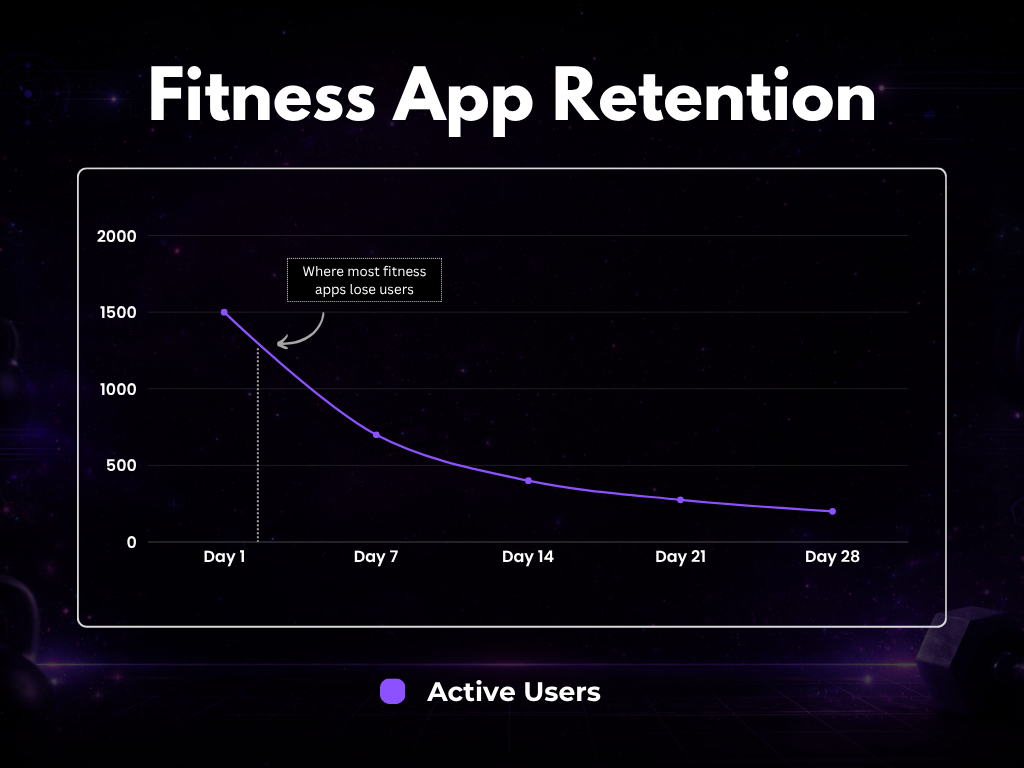
Most plans assume users will keep using the app simply because they want to get fit. In reality, motivation fades quickly. Without a clear system that drives habit formation and ongoing engagement, users churn within days.
If your business plan doesn’t explain why users come back consistently, it’s missing the most important part of the story.
“Feature-First” Approach
Founders love listing all their features. Very few design user behavior.
Let’s face it. Things like workout libraries, meal plans, and progress charts are expected at this point. They don’t create success on their own.
What matters is how those features connect to form a loop that keeps users engaged. If your plan focuses on what the app does instead of how users behave, you’ve missed the entire point.
Unrealistic Subscription Assumptions
It’s a huge mistake to assume users will pay, if you haven’t validated it. Fitness apps often rely on subscriptions. However, many users are resistant to paying unless they see consistent value. Assuming you can generate high conversion rates without proving retention and engagement is one of the fastest ways to lose credibility.
If your plan doesn’t clearly show when users are willing to pay and why, your projections are guesswork at best.
The Takeaway:
Most fitness app business plans don’t fail because the idea is bad or isn’t creative. They fail because they ignore the reality of user behavior. If your plan doesn’t solve that, nothing else matters.
What Investors Actually Look For in Fitness Apps
The average investor has seen dozens (or even hundreds) of fitness app pitches. The vast majority of them sound exactly the same.
Workout plans, check.
Tracking features, check.
Big market size, check.
None of those are enough to impress investors. What investors are really trying to answer is simple. They want to know, “Will users stick, and will this turn into a predictable business?”
Here are the things that investors actually evaluate in fitness app startups.
Proof of Retention (Most Important)
If you can’t get users to come back, you can’t run a fitness app business. Investors care far more about retention metrics than download or signups. Even early signals, like repeat usage or week-over-week engagement, carry more weight than total user count.
A small group of highly engaged users is far more valuable than a large group that churns. If you can prove retention, that’s a great sign that you’re building something worthwhile.
Clearly Defined User Segment
If you’ve defined your audience as “any one who wants to get fit,” you’re positioned completely wrong. Investors want to see focus. This means that you have a clearly defined segment, such as:
- Beginners trying to lose weight
- Busy professionals looking for short workouts
- Athletes optimizing performance
- New parents rebuilding fitness routines
The more specific the segment, the easier it is to build something that actually works.
Habit-Forming Loops
Fitness isn’t a one-time action. Actually, it’s a repeated behavior. Your app needs to create loops that drive consistency, such as:
- Daily workout streaks
- Progress tracking and milestones
- Reminders and accountability systems
- Feedback that reinforces continued use
Investors want to see how your app transforms initial motivation into a long-term habit.
Clear Monetization Timing
Subscriptions are a common monetization strategy for fitness apps, but timing is everything. Investors don’t just want to know how you make money. They want to know:
- When users convert
- What triggers them to pay
- Why they stay subscribed
If monetization comes too early, users churn. If it comes too late, the business struggles to scale. Your fitness app business plan must clearly show how engagement leads to revenue.
CAC vs. LTV Clarity
At the end of the day, you’re building a business. Investors want to understand:
- Customer Acquisition Cost (CAC): How much money it takes to acquire a new user.
- Lifetime Value (LTV): How much revenue that user generates over time.
Without strong retention, lifetime value collapses and the entire model breaks. Ultimately, a fitness app only becomes investable when the numbers prove that users stay long enough to justify the cost of acquiring them.
The Takeaway:
If your exercise business plan can clearly demonstrate these five elements, you’re not just pitching an app. Actually, you’re presenting a system that has wide scalability potential.
Note: While a fitness app business plan is great for helping investors understand your business, a pitch deck is needed to introduce them to it. Learn what slides investors expect here: Pitch Deck Slides Explained
Fitness App Business Plan Structure
In the real world of fundraising, the goal is never to simply “complete” the sections of a business plan. The goal is to prove that your fitness app can actually retain users, build habits, and generate recurring revenue.
Most founders focus on features and market size. Investors focus on whether the system works over time. The sections below aren’t just “sections” for you to fill out. Each one is a test of whether your fitness app can realistically sustain engagement and scale.
Executive Summary
Despite its name, the executive summary isn’t simply a summary. It is a clear argument for why your app is not just “another fitness product” that is going to die in six months.
This section must quickly show:
- A specific target user
- A differentiated approach
- A credible path to retention and revenue
If your executive summary feels generic or feels like something investors have seen before (or 20 times before), the entire plan loses impact. In fact, if you can’t impress them in this section, they’ll never read the rest of the plan.
Common Mistake:
Founders describe features instead of explaining why this app will actually work.
Problem & User Behavior
A fitness app needs a harder-hitting problem than, “People need to get fit.” That’s not a real problem. Instead, your plan needs to define:
- A specific user struggle
- When and why it happens
- How users currently behave
This is about understanding more than just what users want. You need to understand why they fail to stay consistent. If you can’t figure out why they won’t stay consistent with fitness, it’s impossible to prove how you will keep them engaged with your app.
Common Mistake:
Founders focus on outcomes instead of explaining why this app will actually work.
Solution
Your Solution section must go beyond just listing features. An effective plan clearly shows:
- The mechanism (tracking, coaching, gamification, AI, etc.)
- How it fits into a user’s daily routine
- Why it is more effective than existing options
Investors aren’t asking for a list of features. They are asking, “Does this solution actually change behavior?”
Common Mistake:
Founders build feature sets instead of systems that drive consistent use.
Market
The market opportunity is less about how big the fitness industry is. Everyone (not just investors) knows that we live in a weight-obsessed world. Everyone knows the fitness industry is huge.
The market opportunity is really about:
- Who you are targeting first
- How large that segment is
- Why you can realistically reach them
An effective fitness app business plan shows a clear, focused segment. It doesn’t show a broad audience that includes every person who may want to lose a few pounds or get fit at some point in the future.
Common Mistake:
Founders try to appeal to everyone instead of deeply solving a problem for one specific group.
Business Model
Clarity is critical in this section. To write a section that impresses investors, you must define:
- Subscription model (monthly/annual)
- Freemium structure (what’s free vs. paid)
- Upsells (coaching, premium plans, content)
Most importantly, you must explain why users are willing to pay.
Common Mistake:
Founders assume users will subscribe without proving sustained value.
Go-To-Market
This section defines how you actually get users. To make it effective, you need to show:
- Acquisition channels (influencers, communities, content, partnerships)
- How you reach your specific audience
- How you build early traction
Fitness apps often rely heavily on distribution and community-driven growth. Your business plan should reflect this.
Common Mistake:
Founders assume users will come organically without a clear strategy.
Retention Strategy
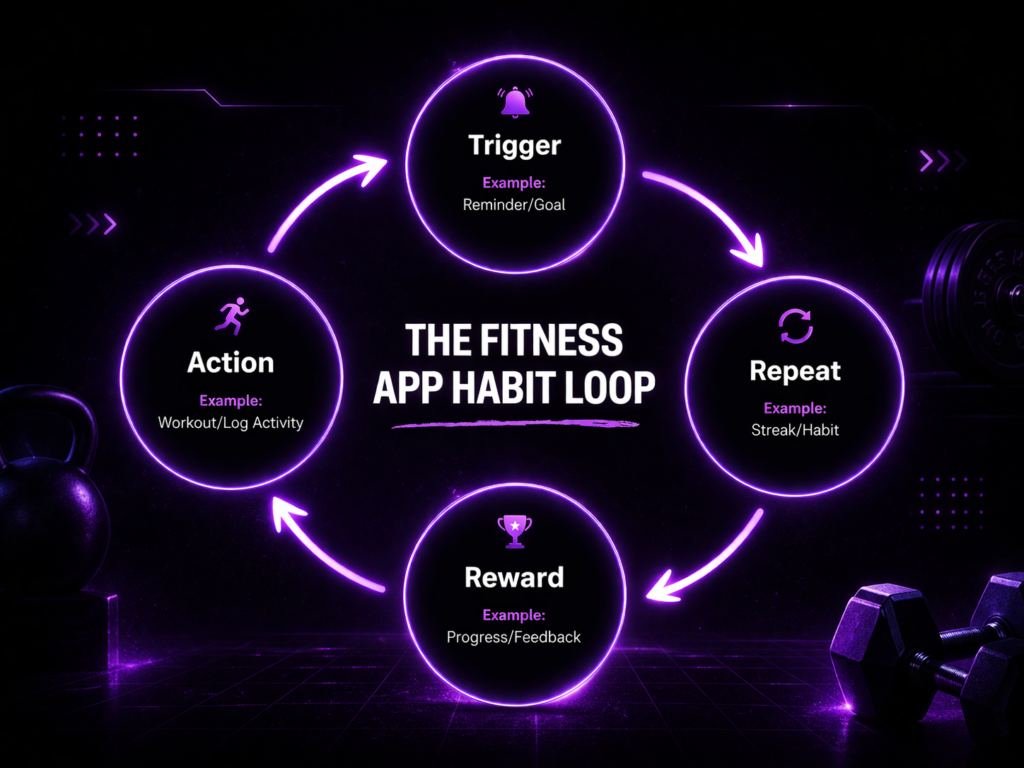
Retention is the most important part of an exercise or fitness app business plan. To get investors to lean in, you must clearly explain:
- How users build habits
- Why they return daily or weekly
- What keeps them engaged over time
This includes:
- Habit loops
- Scheduled triggers
- Ongoing value delivery
If retention is weak, the business doesn’t work.
Common Mistake:
Founders treat retention as an outcome rather than something that must be designed.
Engagement Loops
Retention is driven by engagement systems. You need to show:
- Streaks and progress tracking
- Milestones and rewards
- Accountability mechanisms (notifications, coaching, social elements)
These loops turn short-term motivation into long-term consistency.
Common Mistake:
Founders include features but fail to connect them in a continuous loop.
Validation
This is where your idea becomes credible. Investors want to see:
- Early usage data
- Retention metrics (even small-scale)
- Engagement signals (repeat sessions, time spent)
Even limited traction is valuable if it shows real behavior.
Common Mistake:
Founders present assumptions instead of real user data.
Financials & Funding
The Financials section ties everything together. It’s the grand finale where investors get to see how all your strategies pay off in the end. You must show:
- How retention drives subscription revenue
- How user growth translates into recurring income
- What funding is needed and what it unlocks
Your projections should reflect:
- Realistic retention rates
- Conversion to paid users
- Cost of acquiring users
Common Mistake:
Founders present optimistic numbers without grounding them in user behavior.
Why This Structure Matters
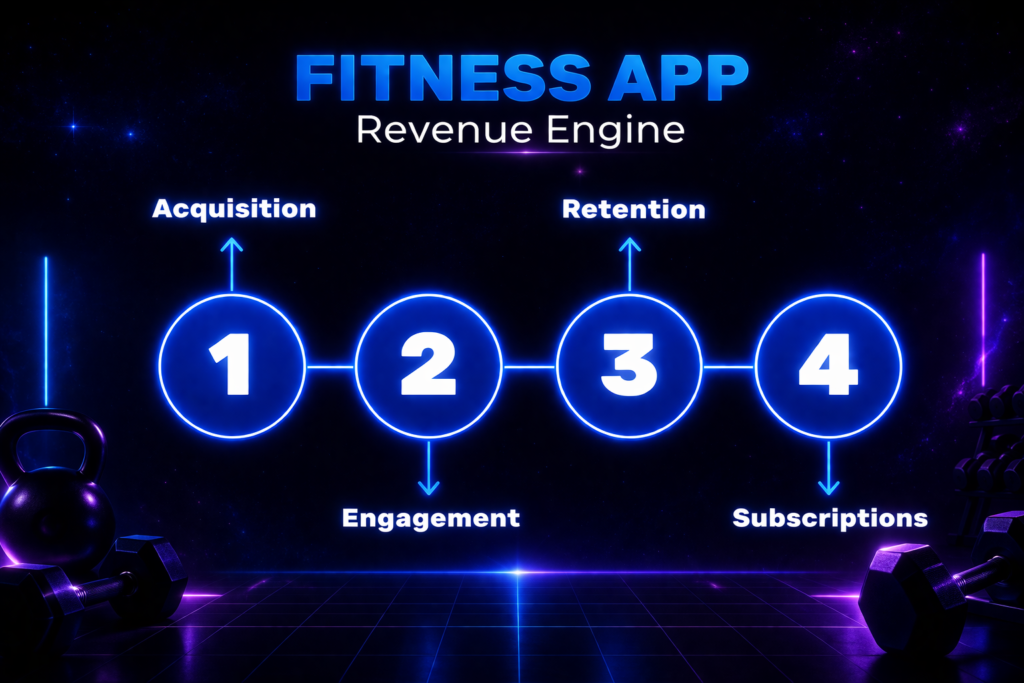
A fitness app business plan is not judged by how polished it looks. It is judged by whether the system works:
- Users join
- Users stay
- Users build habits
- The business generates recurring revenue
If any part of the system is weak or breaks, everything else follows.
Note: While a fitness app business plan is great for helping investors understand your business, a pitch deck is needed to introduce them to it. Learn what slides investors expect here: Pitch Deck Slides Explained
Building An Investor-Ready Business Plan
At this point, it should be clear that a fitness app business plan is not something you want to piece together manually. That is exactly why we built a structured system for this:
This isn’t just a template. It’s a system:
- Step-by-step guidance through every section
- Built around retention, habit formation, and monetization
- Designed to help you think like an investor, from their perspective
If you want to build something that doesn’t just look complete, but actually holds up to investor scrutiny, this gives you the structure to do it properly.
Fitness App-Specific Challenges Most Founders Miss
Fitness apps don’t fail because people don’t want to get fit. Even the fittest people in the world want to be more fit.
In reality, they fail because human behavior is inconsistent. Committing to losing weight or working out on January 1st is easy. Sticking to it by January 3rd is much more difficult. Most products aren’t built to handle this inconsistency.
Rapid User Drop-Off
With fitness apps, the biggest drop happens early. Users download the app with high motivation, use it for a few days, then disappear. If your product doesn’t create immediate value and a reason to return, it loses momentum quickly.
Motivation Decay
Motivation is temporary. Even the most motivated users lose consistency over time. Your app must account for this by creating systems that work even when motivation is low.
Content Fatigue
Adding more content to an exercise or fitness app doesn’t equate to more engagement. Workout libraries, meal plans, and videos can quickly become overwhelming or repetitive. If users don’t feel progression or personalization, they disengage.
Subscription Churn
Getting users to subscribe is only part of the overall challenge. Keeping them subscribed is much harder. If users don’t see ongoing value (and sometimes, even if they do), they cancel quickly. This makes retention directly tied to revenue.
Common Mistakes in Fitness App Business Plans
Many failed fitness app business plans follow the same patterns. They look solid on the surface, but they break when you examine how the product actually works. Some of the most common mistakes include:
- Copying Existing Apps: Recreating features from popular apps is a losing strategy. Copycats rarely survive. If your plan doesn’t clearly explain why your app is different (and why that difference matters), it will not stand out in an already crowded market.
- No Retention Strategy: Many plans focus on acquisition and ignore what happens after users sign up. Without a clear system for keeping users engaged, the business cannot scale.
- Overestimating Subscriptions: Assuming users will pay without providing long-term value is one of the most common mistakes. Subscriptions and only work when retention and engagement are already strong.
- No Niche Focus: If you try to serve everyone, you end up with weak positioning. Strong fitness apps start with a specific user group and build depth before expanding.
Note: Learn more about developing an investor ready mobile app business plan here: Mobile App Business Plan – How To Build One That Actually Gets Funded
Should You Use A Fitness App Business Plan Template?
There are many business plan templates online, but the majority aren’t built for fitness apps. They focus on format and structure, but ignore the behaviors that actually determine success.
Where Most Templates Fall Short
Most business plan templates fall short because they:
- Ignore habit loops entirely
- Treat retention as an afterthought
- Overlook engagement design
- Focus on features instead of user behavior
They help you organize ideas, but not build a system that works.
What a Strong Template Should Actually Do
A real fitness app business plan template should:
- Guide how users build habits over time
- Help you design retention and engagement loops
- Show how behavior connects to monetization
- Surface gaps before they become problems
It should function as a behavior-driven system, not a checklist.
The Difference With a Structured System
That is exactly how we built our Fitness App Business Plan Template. It is:
- Step-by-step and guided
- Built specifically around retention, engagement, and monetization
- Designed to help you think like an investor
Instead of asking what to write, it helps you understand whether your app will actually work.
Build Your Plan the Right Way
At this point, the pattern is clear. This is not about simply writing a document. It is about building a system where:
- Users join
- Users stay
- Users build habits
- The business generates recurring revenue
Most founders try to piece this together manually. But they miss critical gaps.
That is where things break.
Use a System Designed for This
- Step-by-step guidance through every section
- Built around habit formation and retention
- Designed to align engagement with monetization
- Structured to help you build something that actually scales
If you are serious about building a fitness app that works in the real world, this gives you the structure to do it properly.
FAQs About Fitness App Business Plans
Most fitness apps generate revenue through:
– Subscriptions (monthly or annual access to premium features)
– Freemium upgrades (unlocking advanced workouts, plans, or tracking)
– Coaching or personalized programs
– In-app purchases (specialized content, challenges, or add-ons)
The key is aligning monetization with value. Users are more willing to pay when the app consistently helps them make progress
Costs vary depending on complexity, but typically include:
– Product development (MVP to full platform)
– Design and user experience
– Content creation (workouts, plans, videos)
– Marketing and user acquisition
– Infrastructure and scaling
An initial version can range from tens of thousands to significantly more, depending on features and speed of development.
Successful fitness apps share a few key traits:
– A clearly defined target user
– Strong retention and engagement
– Habit-forming systems
– Consistent value delivery over time
– A monetization model that fits user behavior
Ultimately, success comes down to whether users keep coming back.
Retention comes from building systems that support consistency, not just motivation. This includes:
– Habit loops (daily or weekly routines)
– Progress tracking and visible improvement
– Reminders and accountability mechanisms
– Personalization and adaptive content
The goal is to make the app part of the user’s routine, not just something they try once.
Final Thoughts
Fitness apps don’t fail because of a lack of demand. They fail because they don’t account for how people actually behave.
If your plan is built around features, it may look strong on the surface but struggle in reality. If it is built around behavior (how users start, engage, drop off, and return), you begin to see what actually matters.
That is the difference between building an app people download and building one they keep using.eak with one of our app startup experts!