
Updated: April 2026
Starting a food truck sounds like it should be simple. You pick a concept, buy a truck, and start selling food. The media picks up on your existence, and success comes shortly after. In reality, most food trucks fail; and this happens because they never build a clear, structured food truck business plan.
A food truck isn’t just a “mobile kitchen”. It’s a location-dependent, margin-sensitive, operations-heavy business where small mistakes can destroy profitability quickly. This is why a proper food truck business plan is critical.
In this guide, you’ll learn:
- exactly how to write a food truck business plan step-by-step
- what actually matters (not generic SBA fluff)
- real-world considerations most guides ignore
- how to build your plan using a structured template
Note: If you want to skip ahead, you can use our interactive Food Truck Business Plan Template to build your plan as you go.
What Is a Food Truck Business Plan?
A food truck business plan is a structured, strategic document that explains how your food truck will operate, attract customers, generate revenue, and ultimately, become profitable. At its core, it’s more than just a way to describe your idea. It’s a decision-making framework for investors.
A food truck business plan forces you to define how your business will function in the real world, where success is determined by execution, not just your concept.
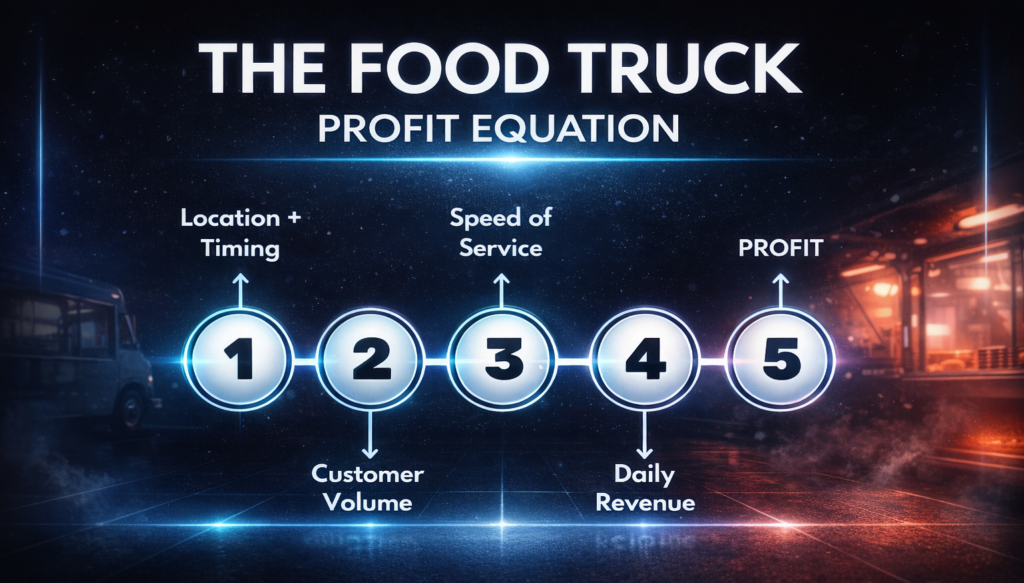
Unlike many traditional business models, food trucks operate in a dynamic and constrained environment. You are not just managing a product. You are managing location, timing, speed, cost efficiency and compliance simultaneously. A proper business plan brings all these variables together in a single, cohesive strategy.
Definition
A food truck business plan is a detailed document that outlines a food truck’s concept, target market, operating strategy, revenue model, cost structure, and growth plan, with the goal of validating viability and guiding execution.
What A Food Truck Business Plan Does
An effective food truck business plan isn’t just a document that’s quickly put together for the sake of “completion.” Its real purpose is to answer one critical question: Can this business realistically work? And the goal is to answer this before investing in it. To do that, it must clearly define three things:
- It explains how your food truck will attract consistent demand. This includes identifying where your customers are located, when they are most likely to purchase, and why your concept fits their preferences.
- It outlines how the business will operate on a daily basis. This includes how food is prepared, how quickly orders can be fulfilled, how staff will function in a limited space, and how inventory and supply chains will be managed.
- It breaks down how the business will make money. This includes pricing, expected order volume, revenue streams such as street sales or events, and the full cost structure required to run the truck.
Without these elements clearly defined, a food truck is operating on guesswork.
Food Truck vs. Traditional Business Plan
You can find many business plan templates online, but the vast majority are built for fixed-location businesses with stable demand patterns. Food trucks are fundamentally different.
A food truck does not benefit from consistent foot traction in one location the one a stationary restaurant does. Instead, revenue is directly tied to where and when you choose to operate. A strong lunch location may outperform a weak dinner location by several multiples, even with the same menu.
Additionally, demand is highly time-sensitive. A two-hour lunch window can generate the majority of daily revenue, meaning that speed of service and operational efficiency are crucial to success.
There are also physical constraints that traditional businesses do not face. Limited space affects how many menu items you can realistically offer, how quickly food can be prepared, and how many customers you can serve during peak periods.
Finally, regulatory requirements are more complex than many first-time founders expect. Health department approvals, parking restrictions, and commissary kitchen requirements can all impact whether your business is even allowed to operate.
Because of these factors, a generic business plan just simply isn’t enough. A food truck business must reflect the operational reality of a mobile, high-efficiency food business.
The True Purpose of a Food Truck Business Plan
Most founders believe a business plan is simply something you write for a bank or investor. In reality, its most important role is internal. It helps you identify problems before they become expensive mistakes.
For example, a business plan can reveal that your menu takes too long to prepare during peak hours, limiting how many customers you can serve. It can show that your chosen locations do not generate enough consistent traffic. It can expose that your pricing doesn’t support your cost structure.
These insights are far more valuable before you purchase a truck than after. A well-built plan reduces uncertainty, clarifies your strategy, and gives you a realistic understanding of what it will take to succeed.
Why You Need A Food Truck Business Plan
Many founders skip this important step. Skipping it is the primary reason why so many food trucks fail within their first year.
On the surface, building a food truck business looks straightforward. After coming up with a concept, you buy a truck, and start selling items. But once you’re operating, reality hits quickly. Margins are tighter than expected, locations don’t perform the way you thought, and small inefficiencies start compounding into real financial problems.
A well-thought out business plan is what prevents that. It forces you to slow down, think clearly, and validate whether you idea actually works before you commit significant time and capital.
It Helps You Avoid Expensive Mistakes
The biggest risk founders face when starting a food truck isn’t a lack of effort. Most founders have a strong work ethic in the earliest days. The real issue is that they make the wrong decisions early.
A business plan helps you identify and make the right decisions before they cost you. For example, many first-time owners invest heavily in a fully customized truck without validating demand or refining their concept. Others create menus that are too complex to execute efficiently, which slows down service and limits revenue during peak hours.
Location mistakes are also extremely common. Choosing low-traffic areas or inconsistent selling spots can make even the best food truck concept struggle.
Each of these mistakes alone can cost tens of thousands of dollars. A well-structured plan helps you see them in advance and adjust before you commit.
It Forces You To Understand Your True Costs
A common reason for food truck failure is miscalculated expenses. At a glance, expenses seem simple. But once you break it down, the cost structure is much more complex than most founders expect.
Beyond food and labor, you need to account for ongoing expenses like fuel, maintenance, insurance, permits, licensing, and in some cases, commissary kitchen fees. If you plan to run your truck at events, there may also be vendor fees that significantly impact your margins.
If you go into it without a plan, you will likely underestimate these costs or overlook them entirely. A business plan forces you to map out your full cost structure and understand what your margins actually look like after everything is accounted for.
It Proves Whether Your Idea Is Actually Viable
Before you spend money (yours or someone else’s) on a truck, equipment, or inventory, you should be able to answer a simple question: Will this business realistically make money?
A business plan helps you answer that by connecting all the moving parts. It requires you to define where your revenue will come from, how often you will operate, how many customers you can realistically serve, and what your average transaction looks like.
From there, you can estimate how much revenue you can generate on a daily, weekly, and monthly basis. It also helps you determine your breakeven point, or the level of sales required to cover your costs.
If the numbers work well on paper, they may work well in real life (not guaranteed). However, if the numbers don’t work on paper, they’ll never work in an actual food truck operation.
It Gives You A Clear Operating Strategy
Food trucks have a high failure rate. Most of those who fail do so because of inconsistent execution. Without a clear plan, operators tend to make reactive decisions. They move locations too often, change menus frequently, or operate without a defined schedule. This makes it difficult to build consistency, customer loyalty, and predictable revenue.
A business plan creates structure. It defines where you will operate, when you will operate, and how your daily workflow will function. It ensures that your menu, pricing, and operations are aligned with your capacity and demand. This level of clarity is what turns a food truck from a side hustle into a real scalable business.
It Helps You Secure Funding and Opportunities
Many food trucks are self-funded. Still, there are situations where a business plan may be essential. You may be required to present a clear business plan if you are applying for:
- small business loans
- grants or local funding programs
- partnerships or shared spaces
- event approvals or vendor opportunities
Even when it is not formally required, having a business plan positions you more seriously. It shows that you understand your business, your market, and your financials.
It Reduces Risk Before You Commit Capital
Starting a food truck often requires a significant upfront investment. Between the truck, equipment, permits, and initial inventory, costs can quickly reach tens of thousands of dollars. Once that money is spent, your flexibility is limited.
A business plan allows you to test your assumptions before you reach that point. It helps you identify weaknesses, refine your concept, and build a strategy that is grounded in reality.
In many cases, the insights gained from planning can save more money than the entire cost of creating the plan itself.
The Bottom Line
A food truck business plan is not just a document. It is a tool for thinking clearly about your business before you build it.
It helps you:
- avoid costly mistakes
- understand your true costs
- validate your revenue potential
- operate with consistency
- reduce risk from day one
If you take the time to build a real plan, you vastly increase your chances of long-term success.
Note: Building a mobile app for your food truck? Learn how to write a mobile app business plan: Building A Mobile App Business Plan That Actually Gets Funded
How To Write A Food Truck Business Plan
Writing a food truck business plan is not about filling out sections. It’s about building a clear, realistic model of how your business will actually operate day-to-day.
Each section below plays a specific role. Together, they answer the only question that matters:
Can this food truck consistently generate revenue and operate efficiently?
Executive Summary
Your executive summary is the first thing people read, but it should be written last.
This section is more than just a summary of your business plan or an introduction to your food truck concept. it is a clear, concise explanation of your entire business.
A strong executive summary should quickly communicate:
- what your food truck is
- who it serves
- how it makes money
- why it will succeed in a specific market
This section should feel focused and direct. If someone reads only this section, they should still understand your concept and why it works.
Most weak plans fail here by being vague. Strong plans are specific and detailed.
Concept & Menu Strategy
Your concept defines your identity, but your menu determines your execution. This is where many food trucks fail early. A strong concept clearly defines:
- your cuisine type
- your core menu items
- your price positioning
- what makes your truck different from others nearby
However, success is not about variety. Ultimately, it is about efficiency. Food trucks operate in limited space, under time pressure, with high demand peaks. That means your menu must be designed for speed, consistency, and margin.
The strongest operators focus on:
- a small, focused menu
- fast preparation times
- high-margin items that are easy to produce
Overcomplicating your menu is one of the fastest ways to reduce throughput and profitability.
Target Market
A food truck does not serve “everyone.” It serves specific groups of people in specific places at specific times. A strong business plan clearly defines who your customers are and how they behave.
For example, your target market could include office workers during lunch hours, college students between classes, event attendees on weekends, or late-night crowds in entertainment districts. The key is to go beyond general demographics.
You need to understand:
- where your customers are physically located
- when they are most likely to buy
- what they are looking for in that moment
This directly impacts your pricing, menu design, and operating schedule.
Location & Sales Strategy
This is one of the most important sections in your entire plan. A food truck’s success is not just about what you sell. It is also about where and when you sell it.
Your business plan must clearly define:
- your primary operating locations
- backup or alternative locations
- your event strategy
- your daily and weekly schedule
Effective plans show how locations align with demand. For example, a lunch-focused truck should prioritize high-density business areas, while a late-night concept should target nightlife zones.
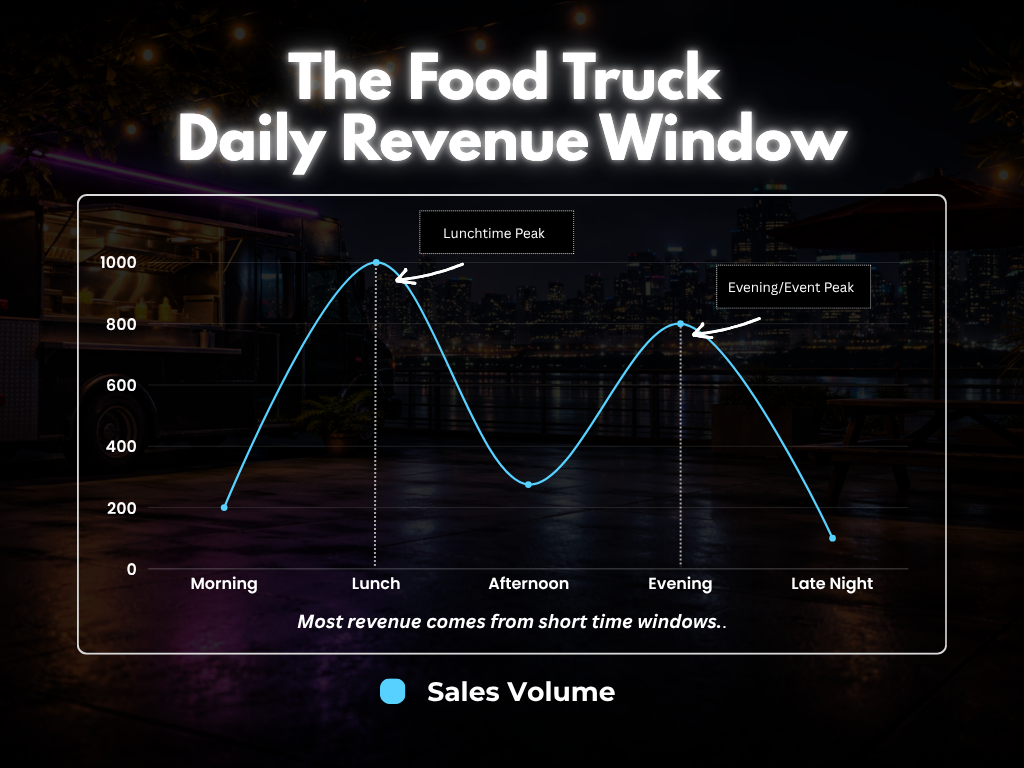
Without a clear location strategy, revenue becomes inconsistent and difficult to predict.
Competitive Analysis
Your competition is not just other food trucks.
It includes nearby restaurants, fast-casual options, and any alternative your customers have.
A strong competitive analysis looks at what others are doing well and where they fall short.
This helps you identify your advantage.
That advantage could come from:
- faster service
- better pricing
- a more focused concept
- stronger branding
- a more convenient location strategy
The goal is not to copy what works. The real goal is to find where you can win.
Revenue Model
Your revenue model explains how your food truck actually generates income. Most food trucks rely on a combination of:
- daily street sales
- event-based sales
- catering or private bookings
But it’s not enough to list these. You need to estimate how they perform. A strong plan defines:
- your average ticket size
- how many customers you can realistically serve per hour
- your expected daily volume
- your projected weekly and monthly revenue
These numbers should go beyond just optimistic assumptions and reflect your operational capacity.
Operations Plan
This section explains how your business runs in real life.
It should outline:
- your food preparation process
- how orders are handled
- staffing roles and responsibilities
- how inventory and supplies are managed
Because food trucks operate in tight spaces with limited staff, efficiency is critical. Every step of your workflow should be designed to:
- reduce wait times
- maximize output during peak hours
- maintain consistent quality
This is where strong operators separate themselves from average ones.
Permits & Legal Requirements
Food trucks are heavily regulated, and requirements vary by location. Your plan should clearly outline what is required to operate legally in your area. This often includes:
- food service permits
- health department approvals
- parking or vending licenses
- business registration
In some cases, you may also need access to a commissary kitchen. Failing to properly plan for permits and compliance can delay your launch or shut your operation down entirely.
Marketing Strategy
Food trucks are local businesses, and their success depends on visibility. Unlike traditional restaurants, you are not in one fixed location. That means your customers need to know where to find you.
A strong marketing strategy focuses on consistency.
This typically includes:
- regular updates on platforms like Instagram or TikTok
- clear communication of your location and schedule
- partnerships with local events or businesses
- building a recognizable brand within your community
The goal is to create familiarity and repeat customers, not just one-time traffic.
Financial Plan
Your financial plan ties everything together. It should clearly outline:
- your startup costs
- your ongoing monthly expenses
- your projected revenue
- your break-even point
This is where many business plans become unrealistic. In contrast, Strong plans use conservative assumptions and reflect real operating constraints, such as limited serving capacity and fluctuating demand.
If your numbers only work under perfect conditions, they are not reliable.
Funding Requirements
If you need external funding, this section explains exactly what you need and why.
You should clearly define:
- how much capital is required
- what it will be used for
- how it supports your launch and growth
This could include:
- truck purchase or buildout
- equipment
- permits and licensing
- initial inventory and marketing
A strong funding section shows that your capital needs are directly tied to a clear plan.
Note: Launching a food truck startup, or any startup, can be difficult. Learn how veteran founders launch startups quickly: How To Launch A Startup
Food Truck Startup Costs Breakdown
Starting a food truck requires a significant upfront investment, and costs can vary widely depending on your setup.
Most food truck startups include the following expenses:
- truck purchase or buildout, which typically ranges from $40,000 to $100,000 depending on customization
- kitchen equipment, often costing between $10,000 and $30,000
- permits and licenses, which can range from $2,000 to $10,000 depending on your location
- initial inventory, usually between $2,000 and $5,000
- branding and marketing, which may require $1,000 to $5,000
Understanding these costs early helps you avoid undercapitalization and plan realistically.
Common Mistakes to Avoid
Most food truck business plans fail for predictable reasons.
- Overcomplicating the Menu: More items may seem appealing, but they slow down operations and reduce efficiency.
- Poor Location Planning: Without consistent, high-traffic locations, even strong concepts struggle to generate revenue.
- Underestimating Costs: Ongoing expenses like maintenance, fuel, and event fees can quickly reduce margins.
- Non-Compliance: Ignoring permits and regulatory requirements can delay or prevent operations entirely.
- Inconsistency: inconsistency in schedule, location, or branding makes it difficult to build a loyal customer base.
FAQs About Food Truck Business Plans
To write a food truck business plan, you need to clearly define your concept, target market, location strategy, operations, and financials.
A strong plan explains:
– what you are selling and why it stands out
– where and when you will operate
– how you will attract customers
– how much revenue you can realistically generate
– what your costs and margins look like
The easiest way to do this is by following a structured framework or using a guided template.
Most food trucks cost between $50,000 and $150,000 to start, depending on the level of customization and equipment.
Major expenses typically include:
– truck purchase or buildout
– kitchen equipment
– permits and licenses
– initial inventory
– branding and marketing
Costs vary significantly by location, but underestimating startup capital is one of the most common mistakes.
Yes. While it may not always be required legally, a business plan is essential for understanding whether your food truck will actually work.
It helps you:
– validate your concept
– estimate costs and revenue
– choose the right locations
– avoid costly mistakes
Without a plan, most decisions are based on assumptions rather than data.
A complete food truck business plan should include:
– executive summary
– concept and menu strategy
– target market
– location and sales strategy
– competitive analysis
– revenue model
– operations plan
– permits and legal requirements
– marketing strategy
– financial projections
– funding requirements
Each section plays a role in proving that your business is viable.
Final Thoughts
A food truck is one of the most accessible ways to start a business. However, that accessibility is also what makes it competitive and risky.
Most people focus on the idea. Very few focus on the system behind it. The difference between a food truck that struggles and one that consistently generates revenue is not creativity. It is clarity. Clarity in where you operate, how you serve, what you sell, and how your numbers actually work.
If you take the time to build a real plan, you are not just preparing to launch. You are removing uncertainty before it becomes expensive.
And if you want to build that plan properly, start with the Food Truck Business Plan Template and structure it the right way from day one.