The gaming industry is one of the fastest-growing and most competitive markets in the world. But against popular belief, building a successful game takes much more than just conceptualizing something “fun.” Beyond the product, it’s about building a business around player behavior, retention, and monetization.
Whether you’re launching a mobile game, indie title, gaming app, or full studio, the biggest mistake founders make is jumping straight into development without thinking through important things like:
- How players will find the game
- Why they will keep playing
- How the game will sustain revenue
- What it will actually cost to sustain.
This is where a game business plan becomes a critical element to a startup’s success. This guide will show you exactly how to create one; from defining the game concept and core loop to structuring your monetization model, growth strategy, and financial projections. More importantly, it will help you think like a game business operator, instead of just a game developer.
The reality is, most games don’t fail because of bad ideas. Even amazing concepts fail to get traction. In reality, they fail because the business behind them was never designed to support the product. By the end of this guide, you’ll understand:
- How to structure a complete game business plan
- What investors, publishers, and partners actually look for
- How to validate your idea before investing time and money
Let’s start with the foundation.
Note: Want to move faster through your business plan? Use our Game Business Plan Template to build your plan step-by-step as you go.
What Is A Game Business Plan?
A game business plan is a structured document that explains how your game will be developed, launched, monetized, and scaled. It goes beyond describing the game itself. Ultimately, it defines the entire system behind the game itself. It explains how you acquire players, keep them engaged, and turn that engagement into sustainable revenue.
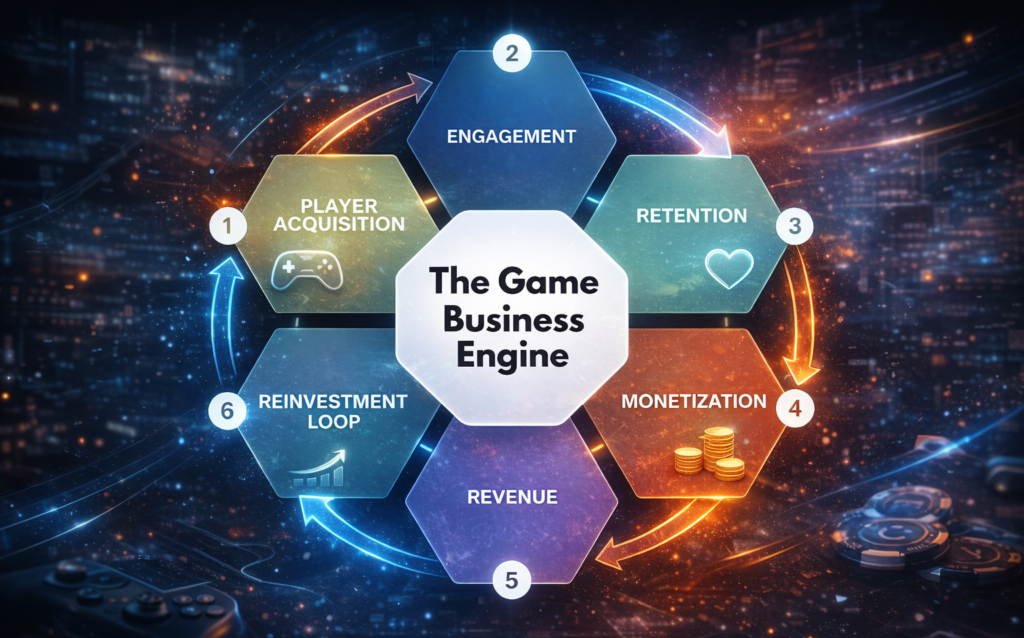
An effective game business plan answers key questions like:
- What is the game and who is it for?
- How will players discover it?
- Why will they keep playing?
- How will it generate revenue over time?
- What does it cost to build and grow?
This applies across all types of game businesses, including:
- Mobile Games – free-to-play, ad-driven, or hybrid models
- Indie Games – premium or small team-projects
- Game Studios – multi-title or scalable operations
- Gaming Apps – gamified platforms or mobile-first experiences
At its core, a game business plan turns an idea into a viable, repeatable business model.
Types of Game Businesses This Guide Covers
This guide is written to support multiple segments in the gaming industry, so you can adapt it to your specific model. These segments include:
- Mobile Game Business Plan: Focused on free-to-play mechanics, in-app purchases, ad monetization, and high-volume user acquisition through app stores.
- PC/Console Game Business Plan: Typically centered on premium pricing, platform distribution (Steam, Playstation, Xbox), and launch-driven revenue with potential expansions or downloadable content (DLC).
What Makes Game Businesses Different
Game businesses operate differently from most startups because success isn’t driven by functionality alone; it is driven by behavior. Game businesses differ from other startups in the following ways:
- Retention-Driven Growth: If players don’t return, the business doesn’t survive. Metrics like daily active users (DAU) and retention rates matter more than downloads themselves.
- Monetization by Design: Revenue is built into the experience itself by way of in-app purchases, ads, subscriptions, or premium pricing. Unlike other startups, if monetization is an afterthought, everything collapses.
- Content Lifecycle Dependency: Games require continuous updates, new content, and live events to maintain engagement and prevent churn.
- Distribution Complexity: Success depends heavily on platform visibility, algorithms, user acquisition costs, and competition within saturated marketplaces.
Game Business Plan (Definition)
A game business plan is a document that outlines how a game will be developed, marketed, monetized, and scaled. It includes the game concept, target audience, monetization strategy, user acquisition plan, retention model, and financial projections, and applies to mobile games, indie games, gaming apps, and full game studios.
Why You Need A Game Business Plan
Most developers skill the business plan step entirely. They focus on game-building elements like mechanics, graphics, and features, without ever defining how the game will actually succeed as a business. That’s the exact reason that most games fail.
A game business plan forces you to think beyond development and answer the questions that determine whether your game survives in the market.
Avoid Building A Game No One Plays
An idea may be amazing to you, but that doesn’t mean gamers want to play it. In addition to the concept, you need to understand:
- Who your target players are
- What they already play
- Why they would switch to your game
Without this clarity, you risk spending months (over even years) building something real with no demand. A business plan pushes you to validate your concept before you build.
Design Monetization Before Development
Most failed games have one major thing in common: they figure out monetization too late.
In gaming, revenue is part of the product experience. Because of this, you need to quickly define:
- How players will spend (in-app purchases, ads, subscriptions, premium)
- When they will spend
- Why they will spend
If monetization isn’t designed into the gameplay loop, it rarely works.
Understand Your Growth Model Early
Receiving downloads is a positive signal, but it’s not the same as building a successful business. You need to understand:
- How much it costs to acquire a player (CPI)
- How much that player is worth over time (LTV)
- Whether your growth is sustainable
Without this, even the greatest game idea can’t succeed.
Prevent Cost Overruns and Scope Creep
Many startups are unpredictable, but game development is notoriously unpredictable. Without a clear plan:
- Features expand endlessly
- Timelines slip
- Budgets get blown
A business plan forces you to define:
- What your MVP actually is
- What can wait
- What resources you need
This keeps your project focused and realistic.
Secure Funding or Publisher Support
If you plan to raise capital or work with a publisher, a business plan is a requirement. Investors and publishers want to see:
- A clear concept
- A defined audience
- A monetization model
- A path to growth
Ultimately, they are funding viable businesses, not ideas.
The Real Reason This Matters
A game business plan isn’t just a required document. It’s your strategy for turning a game into a real system that:
- Attracts players
- Keeps them engaged
- Generates revenue consistently
Without that system, even great games struggle to survive. With it, you give your game a real chance to succeed.
Note: In addition to a game business plan, startups also need a pitch deck to secure investor funding. Get inspired by the world’s best startup pitch decks: 40+ Examples of the Best Pitch Decks Ever
How To Write A Game Business Plan (Step-by-Step)
The truth is, most business plan guides and templates aren’t suitable for game startups. This is why most of them won’t work for your business. The problem with those guides is, they tell you what sections to include, but not what those sections need to prove.
An investor-ready game business plan isn’t about just making sure sections are complete. It’s about showing that your game can attract players, retain them, and generate revenue at scale.
Below is the structure we use for game startups, and an explanation of what each section needs to demonstrate.
Executive Summary
The Executive Summary is more than just a condensed version of the business plan. For investors, it’s a snapshot they use to make decisions. The first decision they are making is whether your business plan is even worth reading. The Executive Summary is what drives that decision.
This section should clearly communicate:
- What your game is
- Who it’s for
- How it makes money
- Why it will succeed
If someone reads this section by itself, they should fully understand the entire opportunity. Most business plans die here because of vagueness. Be direct, specific, and outcome focused.
Game Concept & Core Loop
This section is the foundation of the entire plan. Really, it’s the foundation of the entire business. In this portion of the plan, you need to define:
- Your game genre (casual, hyper-casual, mid-core, etc.)
- The core gameplay loop (what players do repeatedly)
- Progression systems (levels, upgrades, rewards)
- What makes your game different
The key question you want to answer is: Why will players keep coming back?
If your core loop is not compelling, nothing else will save it.
Target Audience
Your business plan should explain exactly who your game is made for. Every game has a specific audience. No game serves “everyone,” and yours won’t either. In your plan, you need to define:
- Who your players are
- What they currently play
- What motivates
Be extremely specific and detail:
- Demographics (age, platform, spending behavior)
- Psychographics (competitive, casual, social, achievement-driven)
Your entire strategy, from design to monetization and marketing, depends on who you define as your target audience.
Market & Competitive Analysis
You aren’t building in a vacuum. You are competing against every other game and activity that attracts your target audience. In this section, you need to show:
- What games already exist in your space
- How they monetize
- Where they succeed and fail
Most importantly, it needs to show where you win within the competitive landscape. That advantage could be:
- A unique mechanic
- Better retention design
- A focused niche
- Stronger branding
Avoid using inflated market size claims. Instead, focus on real, reachable segments.
Monetization Strategy
This is one of the most important sections for a game startup. Your monetization model must align with how players behave in your game. Common models include:
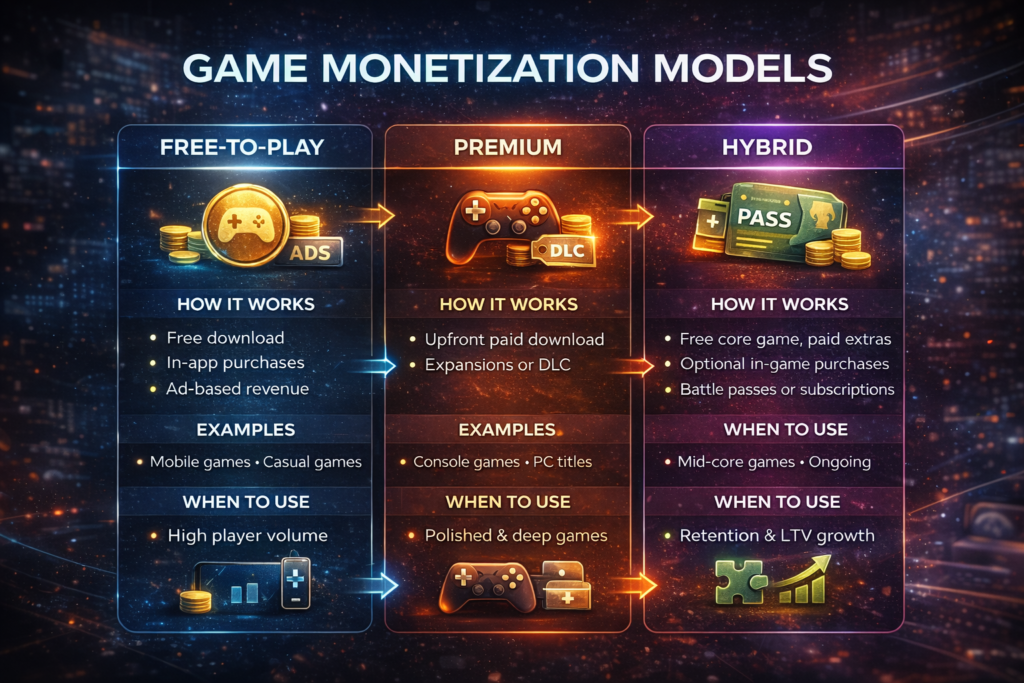
- Free-to-Play (Mobile Focused)
- In-app purchases (skins, upgrades, currency)
- Ads (rewarded, interstitial)
- Premium (PC/Console)
- Upfront purchase
- Expansion or downloadable content (DLC)
- Hybrid Models
- Free-to-play with optional purchases
- Battle passes or subscriptions
Within this section, you need to answer:
- When players spend money
- Why they spend money (what’s the motivation)
- How much they spend over time
If you don’t design monetization into the product experience, it won’t work.
Distribution Strategy
Getting your game built is one thing. Getting it seen is another. Visibility is difficult in such a saturated market.
To create a successful game business plan, you need to define where your game will live:
- App Store/Google Play (mobile distribution)
- Steam/Console Marketplaces (PC and console)
- Direct/Web-Based Platforms
Each channel has:
- Different competition
- Different user expectations
- Different discovery mechanics
Your plan should show how you will stand out and get visibility.
User Acquisition Strategy
If you can’t bring in players, you may have a game but you don’t have a business. You need to explain how you will get your first users and scale from there. This may include:
- Paid acquisition (CPI campaigns)
- Organic growth (social, content, virality)
- Influencers and streamers
- Community building (Discord, Reddit)
The key question is, “Why will players choose your game over thousands of others?”
Retention & Engagement Strategy
Retention and engagement is where most plans fall apart. Downloads have no weight if players don’t come back.
In this section, you need to define:
- Daily/weekly engagement loops
- Rewards and progression systems
- Notifications and re-engagement
- Live events or content updates
The strongest game business plans show:
- How often players come back
- What keeps them engaged
- How engagement compounds over time
Ultimately, retention is the factor that turns a game into a business.
Development Roadmap
The Development Roadmap section shows how your game actually gets built. Here, you should define:
- Your MVP (minimum viable product)
- Key milestones
- Timeline for development
- Tools or engines (Unity, Unreal Engine, etc.)
Keep it realistic. Most founders over-scope and underestimate timelines. Don’t make the same mistake.
Operations & Team
Investors and publishers want to know – who is building and running this game startup?
To answer this, you should outline:
- Key roles (development, design, marketing)
- Team structure
- Outsourced vs. in-house work
Investors are betting on more than just a game. In reality, they are mostly betting on the team behind it.
Financial Plan
This is where everything connects. In the Financial Plan, you need to show:
- Development costs
- Marketing costs
- Expected revenue
- Break-even point
To make this as compelling as possible, tie your numbers to:
- User growth
- Retention
- Monetization
Stay grounded in your assumptions. Unrealistic projections destroy credibility.
Funding Requirements
If you need capital to launch your game startup, be clear and specific. In this section, define:
- How much you need
- What it will be used for
- What milestone it unlocks
Strong plans connect funding directly to:
- Product development
- User growth
- Revenue generation
Note: You don’t need to build this from scratch. If you want a structured way to work through each section step-by-step, you can use our Game Business Plan Template to guide the process and ensure you don’t miss anything critical.
Game Development Costs Breakdown
Most founders underestimate what it actually costs to build and run a game startup. They focus fully on development; but real costs extend far beyond that into marketing, content, and ongoing operations. An effective game business plan breaks these costs down clearly so you understand what it takes to launch, sustain, and grow your startup.
Below is a simplified breakdown of typical game development cost categories:
| Cost Category | What It Includes | Typical Cost Range |
| Development | Programming, game design, core mechanics | $10K – $500K+ |
| Art & Content | Characters, UI, animations, sound, ongoing content | $5K – $200K+ |
| Marketing | Ads, influencers, launch campaigns (CPI spend) | $5K – $300K+ |
| Live Operations | Servers, updates, support, community management | $2K/month+ |
| Tools & Software | Game engines, plugins, licenses | $1K – $20K |
Key Insight: Your cost structure must align with your business model. If your game depends on high user volume, marketing becomes your biggest expense. If it depends on long-term engagement, ongoing content and live operations become critical.
The strongest business plans connect costs to player growth, and player growth to revenue potential.
Note: As noted, creating a game app can be costly. Most founders and developers need pre-seed funding to bring their vision to life. Learn about this fundraising stage here: Pre-Seed Funding Explained
Key Metrics Every Game Founder Must Know
Game startup success is driven by metrics. If you don’t understand the associated metrics, it’s impossible to evaluate whether your game is working.
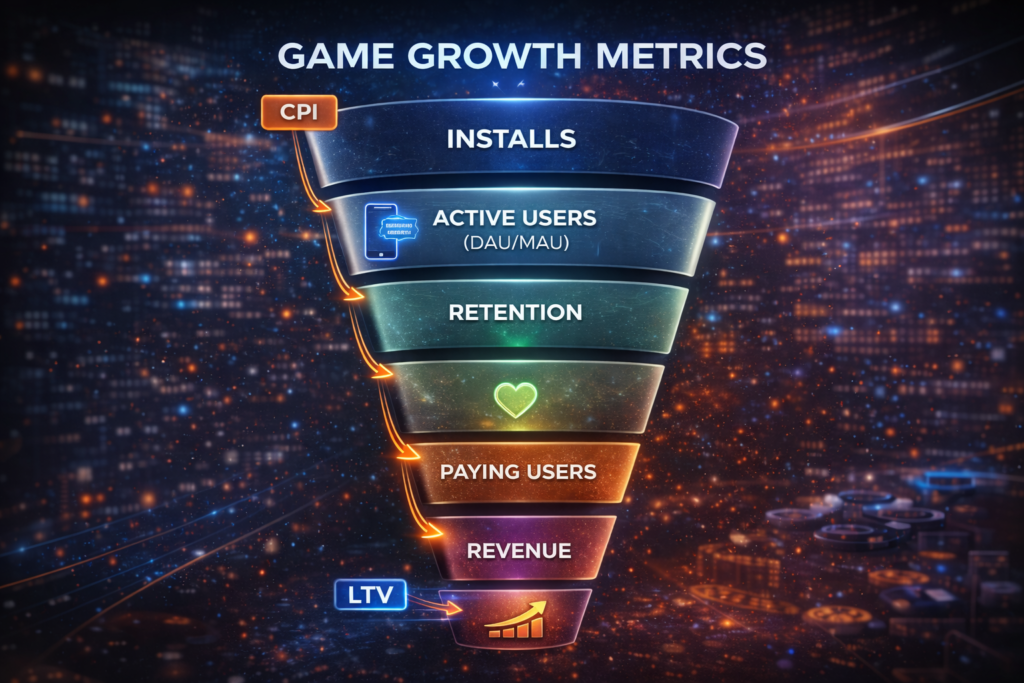
DAU/MAU (Daily & Monthly Active Users)
The metric measures how many players are actively using your game.
- DAU = Daily Engagement
- MAU = Overall Reach
Strong games grow both DAU and MAU.
Retention Rates (Day 1, Day 7, Day 30)
This metric shows how many players return after their first session. This is one of the most important indicators of success.
- Day 1: Initial Interest
- Day 7: Early Engagement
- Day 30: Long-Term Viability
If retention is weak, nothing else matters.
ARPU (Average Revenue Per User)
This metric showcases how much revenue each user generates on average. When you understand this metric, you can see exactly how effective your monetization is.
LTV (Lifetime Value)
Lifetime value equals the total revenue a player generates over their lifetime. This determines how much you can spend to acquire users.
CPI (Cost Per Install)
This represents the expense to the startup for acquiring one user through paid channels. Ultimately a business only works if Lifetime Value (LTV) is greater than Cost Per Install (CPI).
Why These Metrics Matter
These numbers are what investors, publishers, and growth teams actually look at. Your business plan should not only mention them, but it should show:
- How you improve them
- How they connect to your revenue model
Note: While these metrics are important specifically for games, they aren’t the only ones important for startups. Learn more about startup metrics: The Most Important App Metrics To Track for Startup Success
Common Mistakes to Avoid
Most game business plans don’t fail because the founder got the wrong format or structure. They fail because they ignore the realities of how games actually succeed. The most common mistakes with game app business plans include:
- No Retention Strategy: Downloads mean nothing if players don’t come back.
- Weak Monetization Design: If revenue isn’t built into gameplay, it won’t work later.
- Over-Scoped Development: Trying to build too much too early leads to delays and burnout.
- Ignoring Marketing and Distribution: Even great games fail without visibility.
- Copying Competitors Without Differentiation: “Like X but better” is not a strategy.
(INSERT CALL TO ACTION BOX)
FAQ about Game Business Plans
A game business plan should include your game concept, target audience, monetization strategy, user acquisition plan, retention model, development roadmap, and financial projections.
Costs vary widely depending on scope. Indie games may cost $10K–$100K, while larger projects can exceed $500K or more, especially when including marketing and live operations.
Game businesses generate revenue through in-app purchases, ads, subscriptions, premium pricing, or hybrid models depending on the platform and audience.
You can launch without one—but most games that do fail due to poor planning around retention, monetization, and growth.
Investors focus on retention potential, monetization design, user acquisition strategy, and whether the team can execute and scale the game successfully.
Final Thoughts
A successful game doesn’t happen by coincidence. It’s designed from the beginning as a system. A system that attracts players, keeps them engaged, and turns that engagement into revenue over time.
Most founders focus on the game itself. Very few focus on the business behind it. That’s the difference.
If you take the time to think through retention, monetization, distribution, and growth before you build, you dramatically increase your chances of success.
If you want to do it properly, don’t try to piece it together from scratch. Instead, use a structured system, build it step-by-step, and make sure every part of your game is aligned with how real game businesses actually work.