Updated: April 2026
Healthcare and medical app founders often approach a business plan like a document. Investors don’t. In contrast, they see a business plan as a risk assessment. For healthcare and medical app startups, the bar for that assessment is significantly higher.
With this type of business, you aren’t just pitching a product. You’re stepping into a system defined by regulation, clinical responsibility, long sales cycles, and high trust requirements. These qualities change everything.
A typical startup business plan might get away with strong storytelling and aggressive projections. However, this isn’t the case for a healthcare or medical app business plan. If anything feels unclear, unrealistic, or unproven, investors assume the risk is higher than the opportunity.
This is where founders struggle. They focus too heavily on features instead of real clinical problems. Or, they underestimate regulatory complexity. As a result, their plan looks complete on the surface but falls apart when investors actually read it.
Why This Guide?
This guide is different. We’re not going to walk you through a generic, textbook-style business plan. Instead, we are going to show you how investors actually evaluate healthcare and medical app business plans, what they expect in each section, and where most plans break down.
By the end of this guide, you will understand:
- What an investor-ready healthcare app business plan actually requires
- How each section should be framed to reduce risk and build credibility
- Why structure matters more than most founders realize
Ultimately, this is not just about writing a plan. It’s about proving that your startup is one worth funding.
What is a Healthcare App Business Plan?
Definition (Investor-Focused)
A healthcare app business plan is a structured document that explains and interprets how a digital health solution solves a real clinical or operational problem, complies with regulatory requirements, and generates revenue within the constraints of the healthcare system.
At a minimum, a healthcare or medical app business plan should clearly define:
- The healthcare problem and who experiences it
- The solution and how it fits into clinical or patient workflows
- The regulatory and compliance approach (HIPAA, FDA, data security)
- The business model and who actually pays
- The go-to-market strategy within healthcare environments
- Evidence of validation, traction, or real-world demand
Most business plans are about opportunity. However, for a healthcare app startup, it’s about proving that the business can operate safely, legally, and realistically inside a traditionally complex system.
Medical App Business Plan vs. Standard Business Plans
The focus of most startup business plans is speed, scalability, and market opportunity. Healthcare plans, though, are centered around risk, trust, and feasibility.
Key differences between healthcare app plans and standard app business plans include:
- Regulation is not optional, it’s central
You must address compliance early. Waiting until later is a red flag.
- Adoption is slower and more complex
You are often selling into institutions instead of general consumers. Decisions involve numerous stakeholders.
- Validation expectations are higher
Opinions aren’t enough for healthcare app business plans. Investors look for clinical input, pilot programs, or early proof.
- The buyer is not always the user
A patient may use the app, but a hospital, insurer, or provider may be the actual customer.
- Integration is as important as innovation
If your solution doesn’t fit into existing medical systems or healthcare workflows, adoption is unlikely.
Why This Definition Is Important
If you approach a healthcare app business plan the way general founders do, you will likely miss the specific areas investors care about most. This is where many medical app plans don’t hold up.
This is why structure is critical. This plan isn’t about just organizing information. Ultimately, it’s about making it easier for an investor to evaluate risk, credibility, and execution potential quickly and easily.
The Problem With Most Medical App Business Plans
Healthcare app business plans don’t typically fail because of a bad idea. On the contrary, founders have presented us with many amazing ideas that could significantly progress the medical industry.
The real reason they fail is because they don’t reduce risk. In healthcare, investors aren’t just evaluating if it’s a good opportunity. Ultimately, they want to see, “Where does this break?” Unfortunately, most plans leave that question unanswered.
Lack of Regulatory Clarity
One of the fastest ways to lose credibility is treating regulation and compliance as an afterthought. It is crucial that your plan clearly addresses:
- Whether your product falls under HIPAA
- Whether FDA oversight is required
- How patient data is stored, secured, and transmitted
If these aren’t addressed, investors will immediately assume that you are unaware of the real risks that may threaten your business.
It isn’t acceptable to just say, “we’ll handle compliance later.” In an investor’s eyes, this signals that you haven’t yet thought through one of the most critical parts of your business.
No Real Validation
Startups are experiments. Still, many founders present ideas as if they are already proven. As if everything is set in stone just because they pulled some promising numbers from an industry report they found online.
They describe the problem, solution, and market opportunity, but don’t show any evidence that people actually want the solution or are willing to adopt it.
In healthcare, validation is a requirement for funding. It is ultimately one of the strongest signals of viability. Investors look for:
- Conversations with providers, patients, or institutions
- Pilot programs or early testing
- Letters of intent or early partnerships
Without this, the plan isn’t presenting a business; it’s showcasing a theory.
Unrealistic Go-To-Market Assumptions
Go-to-Market Strategy is often one of the weakest sections of healthcare app business plans. It’s also the area where most otherwise strong plans show weakness.
Healthcare apps don’t move or operate like a traditional SaaS. Founders often assume:
- Fast sales cycles
- Easy access to decision-makers
- Quick onboarding and adoption
The reality of the situation is usually:
- Sales cycles can take months or longer
- Multiple stakeholders are involved in decisions
- Integration and compliance slow everything down
If your medical app business plan ignores this, you lose credibility. In startups, and especially healthcare startups, credibility is everything.
What This Means For Your Plan
Formatting is important, but investors don’t judge your healthcare app business plan by how it looks. They judge how well it answers the question that matter:
- What are the risks?
- Have they been understood?
- Is there a credible and believable path forward?
Your plan shouldn’t just describe your business. It should prove that it can actually work. That difference usually comes down to structure, clarity, and how intentionally you build each section.
Note: Business plans give investors a deep dive into your business. However, pitch decks introduce your business to investors. Learn the proper format for a pitch deck here: Pitch Deck Slides Explained
What Investors Are Looking For
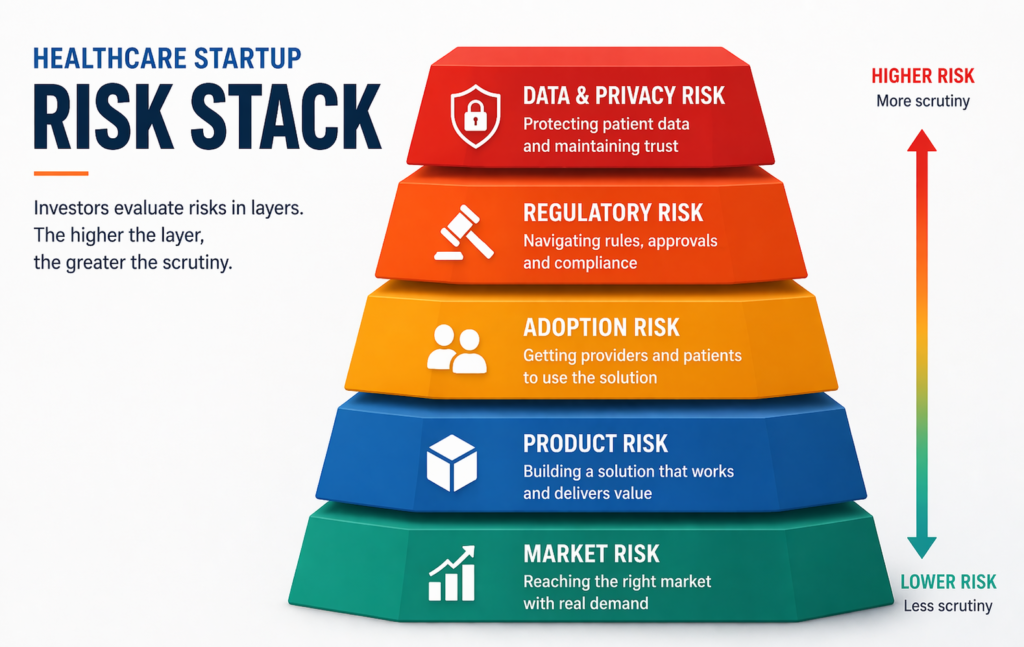
If a potential investor reads your business plan, it’s not because they want to understand your idea. In reality, they are reading it to understand what the risks are and decide whether the projected reward is large enough.
In healthcare, that bar is set even higher. If even the slightest part of the business plan feels uncertain, vague, or overly optimistics, red flags go off.
Here is what investors are actually looking for.
Risk Clarity
We’ve seen founders try to minimize or avoid talking about risk, hoping that investors won’t notice. They always notice.
In a real situation, investors actually look for the opposite. They want to see:
- Regulatory risks clearly identified
- Adoption challenges acknowledged
- Technical or integration constraints addressed
Weak plans only highlight the upside of the business. To an investor, that signals inexperience. Strong plans aren’t the ones that pretend risk is non-existent. They are the plans that show the founders understand the risks and have a believable way to manage them.
Proof of Demand
It’s not enough to just say that a massive problem exists. Even with statistics from the most recent industry reports, the evidence is weak at best.
Investors want evidence that:
- The problem is urgent
- Someone is actively looking for a solution
- Customers are willing to adopt or pay for the solution
This can come in the form of:
- Interviews with healthcare professionals
- Pilot programs or early usage
- Letters of intent of partnerships
Without evidence, you’re leading with an assumption. Would you invest your money in an assumption? Neither will investors.
Adoption Path
Many of the healthcare app business plans we have reviewed fell short in showing a credible adoption path. It’s great that you believe people will use your product. But it’s not enough. You need to show how you will get your product from where it is today into the hands of buyers.
Investors are looking for:
- Who the buyer is (hospital, clinic, insurer, patient)
- How decisions are made
- How your product fits into existing workflows
When it comes to healthcare apps, asking users to change behavior is a huge ask. If your adoption path depends on behavior change, but you haven’t provided enough incentive for them to do so, your plan loses credibility.
Team Credibility
The team is important in any startup. But in healthcare, execution risk is directly tied to the team. Investors want to know:
- Does this team understand the healthcare system?
- Do they have clinical, regulatory, or operational insight?
- If not, have they brought in advisors who do?
Investors don’t expect that your team will know everything, even if your founders are deeply experienced. Still, you must show that you aren’t navigating blindly.
Note: Learn the secrets behind creating a pitch deck team slide that impresses investors: Pitch Deck Team Slide: Examples and What Investors Look For
The Bottom Line
If you want to impress investors, don’t try to convince them. Your true job is to eliminate uncertainty and doubt. A successful business plan is one that gets them there quicker. Doing so requires that it clearly shows:
- Where the risks are
- Why they are manageable
- How this becomes a real, operating business
Never expect that investors will fill in the gaps themselves. They won’t. They’ll just pass and move on.
Medical App Business Plan Structure
To be honest, the question isn’t, “what goes into a business plan?” The real question is how well each section proves your startup can actually work inside the complex realities of the healthcare sector.
This is where many founders go wrong. They treat each section like something they “need to complete” instead of a tool for reducing risk and building credibility.
Below, we’ll give you the structure. More importantly, we’ll dig into how investors think about each part of a healthcare app business plan.
Executive Summary
Don’t let the name deceive you. This section of the business plan isn’t just a “summary.” In reality, it’s a decision filter. If an investor isn’t impressed here, they won’t read another page of your business plan.
In the executive summary, you must quickly prove:
- This is a real, meaningful healthcare problem
- The solution is credible
- There is a viable path to adoption and revenue
Investors judge your entire plan from this one section. If it feels vague or unrealistic, they will assume the rest of the plan will have the same qualities. And they’ll stop reading, right at that moment.
If this section feels vague, inflated, or overly polished, investors assume the rest of the plan will be the same.
Common Mistake:
Founders describe general inefficiencies instead of specific, validated pain points.
Problem & Clinical Context
To create a compelling business plan, you must make it obvious that the problem is real, frequent, and costly (financially or otherwise). Most importantly, it needs to prove that the problem exists within a specific healthcare context.
This section should explain who is experiencing the problem; whether patients, providers, or administrators. If you can’t prove that a high-impact problem exists, the solution doesn’t matter.
Solution
Innovation is important. However, your business plan must do more than just show that you have an innovative idea. More importantly, your solution must:
- Fit into existing workflows
- Be usable in real healthcare environments
- Improve outcomes, efficiency, or cost
Investors don’t just want to see a good idea. They want to know that it will actually be used in practice. Healthcare is a complex industry with high switching costs. If adoption requires major behavior change without strong incentives, it becomes a risk.
Common Mistake:
Founders design for ideal scenarios, not real-world constraints.
Market
This section isn’t about showing the largest potential user numbers possible. It’s actually about proving that there is a reachable market. To do so, this section must clearly define:
- Who the initial customer is
- How large the segment actually is
- Why you can realistically access it
Common Mistake:
Founders inflate market size but cannot explain how they reach even a small portion of it.
Regulatory Strategy
Regulatory is one of the most important sections of a healthcare app business plan. Although many founders skip it, it is not optional. It will be one of the most scrutinized sections of your document.
To prepare this section properly, you must clearly address:
- Compliance (HIPAA, data handling, privacy)
- Whether FDA oversight applies
- How you plan to meet these requirements
If this section is weak or unclear, the entire plan loses credibility.
Common Mistake:
Founders delay thinking about regulation or assume it can be figured out later.
Business Model
In this section, clarity is far more important than creativity. More than anything, investors want to know how your business makes money. This should be clear and to the point.
For this section, you must show:
- Who pays
- Why they pay
- How revenue is generated
In healthcare, the user is often not the buyer. Sometimes the buyer may be an executive within a hospital, while the user is the patient. If that relationship is unclear, the model breaks.
Common Mistake:
Founders assume usage automatically leads to revenue without defining the payer.
Go-To-Market
If this section doesn’t reflect how healthcare actually works, you’ll weaken the believability of the entire plan. To create the most compelling section, you need to show:
- How you reach decision-makers
- What the sales process looks like
- How long it realistically takes
Healthcare apps aren’t like dating apps; sales are rarely fast or simple. They require numerous touchpoints, a plan for contacting decision-makers, and a credible strategy for getting in front of them.
Common Mistake:
Founders apply traditional SaaS growth assumptions to a much slower, more complex system.
Validation
The Validation section is where your plan shifts from “idea” to reality. In your business plan, investors are looking for:
- Evidence of demand
- Real-world feedback
- Early traction or testing
Even small signals can significantly reduce perceived risk.
Common Mistake:
Founders rely on assumptions instead of evidence.
Financials + Funding
If you want the most impactful business plan, this section should connect everything together. Ultimately, this section needs to show:
- How the business makes money
- What it costs to operate
- How funding will be used
Most importantly, your funding ask must be tied to specific milestones. Investors want to know how you will spend their money, and what milestones it will enable you to achieve.
Common Mistake:
Founders present projections without linking them to how the business actually grows.
Why This Structure Matters
The sections of the business plan aren’t just for you to present information. Each section is a signal to investors.
A strong business plan makes it easy for an investor to answer, “Can this realistically become a functioning, scalable healthcare business?” If any section creates doubt, it weakens the entire plan.
Build This the Right Way
At this point, you can see that this is not something you want to piece together from scratch or guess your way through.
That is exactly why we built a structured system specifically for this:
This template provides:
- Step-by-step guidance through every section
- Healthcare-specific considerations built in
- Designed to help you think like an investor, not just fill in a document
If you are serious about building a plan that holds up under real scrutiny, this gives you the structure to do it properly.
Healthcare-Specific Challenges
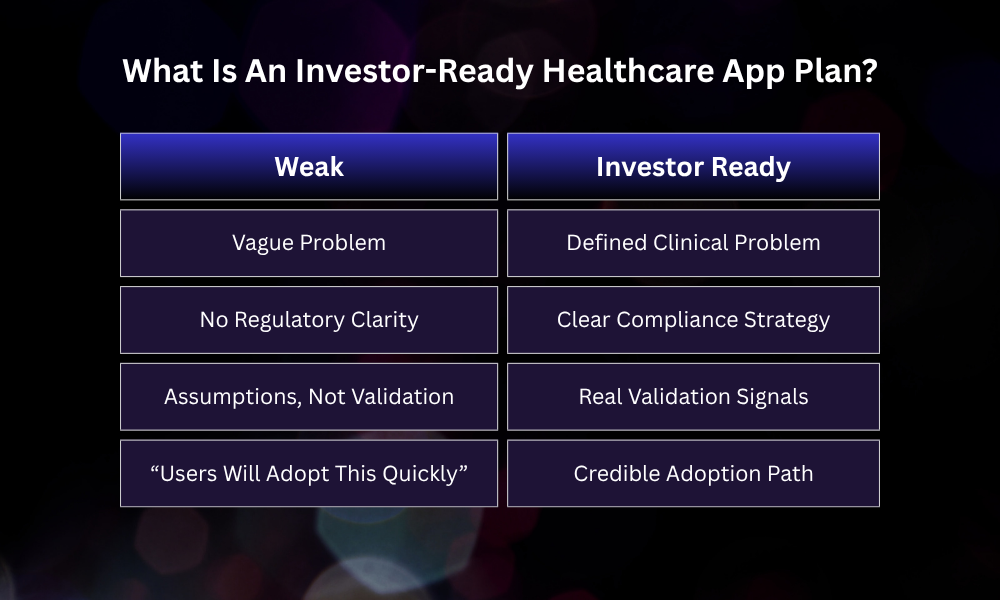
Healthcare has extreme differences compared to other startup types. It operates under constraints that slow down, reshape, and sometimes completely block otherwise strong ideas. Many healthcare founders underestimate these realities early, and it shows up in their business plan.
Here are the most common challenges founders miss.
Regulatory Timeline Are Longer Than You Think
Compliance isn’t something you can think about for a few minutes and write up into your business plan. It is an ongoing process.
Whether it involves HIPAA, data security standards, or potential FDA pathways, timelines can stretch far beyond initial expectations.
If your plan assumes that you will launch rapidly without accounting for long regulatory timelines, it will immediately feel unrealistic.
Sales Complexity Is Built Into The System
When it comes to healthcare apps, you are rarely selling to one person. In this space, decisions often involve administrators, clinicians, IT departments, compliance teams, finance teams, and others.
This creates longer sales cycles, more friction, and a need for clear internal alignment within medical organizations. If your go-to-market strategy doesn’t consider these obstacles, it will fall apart under investor review.
Trust Is Harder To Earn Than Adoption
People don’t just randomly adopt healthcare tools. They are often trusting it with outcomes, decisions, and sometimes lives.
That means:
- Credibility matters early
- Clinical validation carries weight
- Reputation builds slowly
If you don’t have a well-thought strategy for building trust and credibility, you’re missing out on a critical part of your plan.
Data and Privacy Risks Can Kill Momentum
Handling sensitive health data introduces immediate risk to medical app startups. Your plan must clearly address how data is stored and protected, who has access, and how compliance is maintained.
If you can’t make your approach clear, it will quickly raise concern among investors.
Does A Healthcare App Business Plan Template Help?
The vast majority of business plan templates aren’t suitable for healthcare app startups. They are generic frameworks designed to help you organize information – not to build something that can truly survive investor scrutiny. That difference matters.
Where Most Templates Fall Short
Typical templates:
- Treat all industries the same
- Ignore regulatory complexity
- Provide surface-level prompts instead of real guidance
- Focus on formatting, not thinking
They help you complete a document, but they do not help you build a credible healthcare business case.
In a space where risk, compliance, and adoption complexity define success, that is a problem.
What An Investor-Ready Template Should Actually Do
A strong medical app business plan template should:
- Guide how each section is structured and framed
- Highlight what investors expect to see, not just what to include
- Incorporate healthcare-specific realities like regulation, workflows, and stakeholders
- Help you identify gaps, risks, and weak assumptions early
It should function less like a checklist and more like a thinking system.
Template vs. System
Our template really isn’t a template at all. In reality, it is:
- A guided, step-by-step system
- Built on an investor-grade framework
- Designed specifically for healthcare startups
- Focused on helping you build credibility, not just complete sections
Instead of asking, “What should I write here?”, it helps you answer, “Does this actually hold up?”
The Healthcare App Business Plan Template You Need
At this point, the pattern should be clear. This is not about writing a document.
It is about building something that can stand up to real scrutiny:
- From investors
- From healthcare stakeholders
- From the realities of the market itself
Trying to piece this together manually usually leads to:
- Missed gaps
- Weak assumptions
- Sections that look complete but fail under pressure
The difference between a plan that gets ignored and one that gets taken seriously is not effort. The difference is structure.
A System Designed For Healthcare Apps
This Healthcare & Medical App Business Plan Template system includes:
- Step-by-step guidance through every section
- Healthcare-specific insights built in
- Designed around how investors actually evaluate risk and opportunity
- Built to help you create something that is not just complete, but credible
If you are serious about building a healthcare startup that can raise capital, this gives you the structure to do it properly.
FAQs: Healthcare & Medical App Business Plans
There is no fixed length, but most investor-ready healthcare app business plans fall between 15–30 pages.
What matters is not length, but clarity.
Each section should directly answer key investor questions around risk, feasibility, and execution without unnecessary filler.
No, but you do need to understand whether FDA oversight applies to your product.
Your business plan should clearly outline:
– Whether your app qualifies as a regulated medical device
– What classification it may fall under
– Your expected regulatory pathway
Investors are not expecting approval yet, but they do expect awareness and a credible plan.
At a minimum, investors expect:
– Revenue projections
– Cost structure (development, compliance, operations)
– Burn rate and runway
– A clear use of funds
More importantly, your numbers should be tied to realistic milestones, not just growth assumptions.
In rare cases, yes. But in most situations, no.
Even if a formal document is not requested, investors will still evaluate:
– Your understanding of the market
– Your regulatory awareness
– Your go-to-market strategy
– Your financial logic
A structured plan ensures you can communicate all of this clearly and confidently.
A fundable healthcare startup typically shows:
– A clearly defined, high-impact problem
– A solution that fits real-world workflows
– Early validation or strong evidence of demand
– A credible regulatory and compliance approach
– A realistic path to adoption and revenue
Ultimately, it comes down to one thing: Does this reduce enough risk to justify investment?
Final Thoughts
At the end of the day, a healthcare app business plan is not something you write once and move on from. It is the clearest reflection of how you think about your business. If your thinking is shallow, the plan will be shallow. If your assumptions are weak, the plan will expose it. That is not a flaw in the process. That is the point. The best founders use this stage to pressure test their own ideas before anyone else does.
If you approach this the right way, the outcome is not just a stronger document. It is a stronger business. You begin to see where adoption will break, where risk is underestimated, and where your strategy needs to evolve. That is what separates plans that get ignored from ones that lead to real conversations. Not because they sound better, but because they are grounded in reality. worked with dozens of mHealth companies, helping them raise money from investors around the world. Contact us today and speak with one of our business plan experts.