Updated: April 2026
Music apps have completely reshaped how people discover, consume, and interact with music. From streaming platforms to creator tools and social listening experiences, users now expect instant access, personalization, and seamless engagement. With so many music apps in the App Store today, the bar is extremely high. For this reason, a music app business plan is core to a startup’s success.
The market is crowded, user expectations are mature, and switching costs are low. If your app doesn’t deliver immediate value and sustained engagement, users won’t stick around. As a result, growth will stall quickly.
This is where most founders fail. They focus on building features instead of designing a business. They launch without a clear monetization strategy, underestimate licensing complexity, or assume users will come without a structured acquisition plan. The result is a product that might work, but doesn’t scale.
A music app business plan forces you to think through all of this before you invest time and money. Specifically, it helps you:
- Define your product and positioning clearly
- Understand your target users and behavior
- Design a monetization model that actually works
- Plan for retention, not just downloads
- Prove viability to investors or partners
In short, it turns your idea into a structured, testable business. In this guide, we’ll walk you through exactly how to create a music app business plan. By the time you get through this guide, you’ll have the information needed to move from concept to execution with clarity and confidence.
Note: Want to move faster through your business plan? Use our Music Business Plan Template to build your plan step-by-step as you go.
What Is A Music App Business Plan?
A music app business plan is a structured document that outlines how your app will attract users, deliver value, manage content, and generate revenue in a competitive and content-driven market.
It goes beyond a standard app business plan by addressing the unique challenges of music platforms, including user retention, monetization models, and content or licensing considerations.
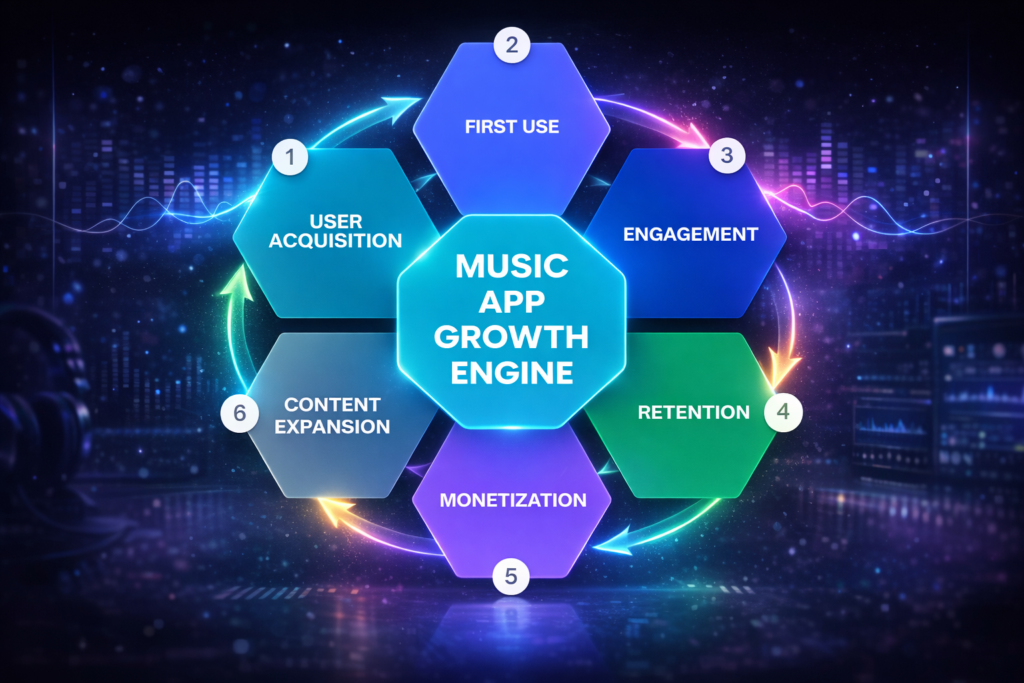
Whether you’re building a streaming platform, a creator tool, or a niche music experience, your business plan should clearly define:
- What your app does
- Who it serves
- How it differentiates from existing platforms
- How it will grow and make money
At its core, a music app business plan transforms your idea into a clear execution strategy that can be validated, tested, and presented to investors or partners.
Types of Music Apps This Guide Covers
This guide applies to a wide range of music-related platforms, including:
- Music Streaming Apps: Spotify-style platforms with on-demand listening
- Music Discovery Apps: Focused on helping users find new artists or genres
- Artist/Creator Platforms: Tools for musicians to upload, distribute, or monetize content.
- Social Music Apps: Community-driven platforms built around sharing and interaction
- Music Learning Apps: Apps that teach instruments, theory, or vocal skills
- Playlist/Curation Apps: Focused on organizing and sharing music collections
Each of these has different mechanics, but they all require a clear plan for growth, engagement, and monetization.
What Makes Music Apps Different
Music apps operate under a different set of rules compared to most startups. The most notable differences include:
- Licensing Complexity
If your app involves streaming or distributing music, you may need licensing agreements or partnerships. Ignoring this can shut your app down before it scales.
- Retention-Driven Growth
Success depends on how often users return. Daily engagements, playlists, and habit formation are critical.
- Monetization Expectations
Users expect free access, which makes converting them into paying customers more difficult than in other industries.
- Content Dependency
Your product experience is directly tied to the availability and quality of music or creator content.
- Platform Competition
You’re competing with deeply entrenched platforms like Spotify, Apple Music, and YouTube, which means differentiation is essential.
Music App Business Plan – Definition
A music app business plan is a document that explains how a music-based platform will attract users, deliver value, manage content or licensing, and generate revenue through models such as subscriptions, ads, or creator tools.
Note: Successful startups often have commonalities. Learn about apps that made millions and find out what they did to succeed: 20 Apps That Made Millions
Why You Need A Music App Business Plan
The most common reason music apps fail is because there is no clear plan behind the product. Founders rush into development, assume users will flock to their solution, and only think about monetization or licensing after launch. By that point, it’s often too late.
A music app business plan forces you to think through the critical pieces before you invest time, money, and resources.
1. Avoid Expensive Product & Licensing Mistakes
Music apps come with obstacles and complexities that most founders underestimate. Common mistakes include:
- Building features users don’t actually need
- Overcomplicating the product early
- Ignoring licensing or content requirements
These mistakes can cost tens of thousands or dollars, or could be the hurdle that keeps you from operating completely. A business plan helps you define:
- What you’re building
- Why it matters
- What is actually required to launch
2. Define Monetization Early
One of the biggest challenges in music apps is turning users into revenue. You need to decide early:
- Subscription vs. Ad-Supported
- Free vs. Premium Access
- Creator Monetization vs. Listener Monetization
Without a clear model, you can grow your user significantly but still fail as a business. A plan forces you to connect usage to value, and value to revenue.
3. Validate Real User Demand
With your music app business plan, you need to answer one simple question: Why would someone use your app instead of what already exists?
Your business plan should clearly define:
- Your target users
- Their behavior and pain points
- What makes your app different
Without these things, you’re guessing. And guessing is expensive.
4. Secure Funding & Partnerships
If you plan to raise money or partner with others, a business plan becomes essential. Investors and partners want to see:
- A clear market opportunity
- A strong monetization strategy
- A realistic path to growth
In music apps specifically, partnerships (artists, labels, and platforms) are often critical. A well-structured plan shows you understand how the ecosystem works.
Note: Not sure if your startup is ready for funding yet? Find out the criteria investors look for: How Do I Know If I’m Ready To Raise Funding?
How To Write A Music App Business Plan (Step-by-Step)
Any business plan guide can tell you what sections to include. However, very few tell you what those sections actually need to prove.
An investor-ready music app business plan isn’t just a document for listing your solution’s features. It’s about showing that your app can attract users, retain them, and generate revenue in a competitive, content-driven market.
Below is the structure we use for creating comprehensive, investor-ready business plans.
1. Executive Summary
This section is your high level overview, but it must be sharp. This is where investors decide if the startup is interesting and positioned well enough to warrant reading the rest of the plan. It should clearly explain:
- What your app does
- Who it serves
- How it makes money
- Why it will succeed
If someone reads only this section, they should fully understand the entire opportunity you are presenting. However, if it’s not strong, they will not turn the page to learn more.
2. App Concept & Core Experience
This is the foundation of your product. In this section, you need to define:
- What type of app you’re building (streaming, discovery, etc.)
- The core user experience (what users do repeatedly)
- How users interact with content
- What makes your app different
The key question you must answer in this section is, “Why will users keep coming back?”
If your core experience isn’t strong, retention will fail.
3. Target Audience
Your target audience needs to be far more granular than “music lovers.” To create an effective business plan, this section needs to define:
- Specific user segments
- What they currently use
- What frustrates them
Some examples of a clear target audience include:
- Independent artists looking for exposure
- Niche genre communities
- Casual listeners vs. power users
Your product, marketing, and monetization all depend on defining a clear and specific customer segment.
4. Market & Competitive Analysis
As a music app founder, you are competing in one of the most established digital markets. In this section of the plan, you need to show:
- Who your competitors are
- How they operate
- Where they fall short
More importantly, you need to explain: Where do you win?
Your advantage might be:
- Niche focus
- Better discovery
- Stronger community
- Creator-first model
Avoid generic “huge market” claims. Focus on real positioning.
5. Monetization Strategy
Monetization Strategy is one of the most critical sections in a music app business plan. Music apps are difficult to monetize because users expect free access. You need a model that aligns with behavior.
Common monetization options for music apps include:
- Subscriptions:
- Monthly or annual plans
- Premium features (offline listening, no ads, exclusive content)
- Ad-Supported Models:
- Free tier with ads
- Revenue driven by user volume
- Creator Monetization
- Tools for artists to earn
- Revenue sharing models
- Tipping, subscriptions, or marketplace features
- Hybrid Models
- Free + Paid Tier
- Ads + Subscriptions + Creator Revenue
In this section, you must clearly define:
- When users convert to paid
- Why they convert
- How much they are worth over time
Weak monetization is one of the most common reasons music apps fail.
6. Distribution Strategy
In the business plan, you must answer: Where will users access your app?
Common channels include:
- App Store/Google Play
- Web platform
- Partnership (artists, labels, platforms)
Each channel has different discovery dynamics. Your plan should clearly explain how you will get visibility in a crowded market.
7. User Acquisition Strategy
If your music app can’t acquire users, then you don’t have a business. You need a clear plan for getting your first users and scaling. This may include:
- Social media content
- Influencer or artist partnerships
- Community building
- Paid acquisition
The key question to answer in this section is, “Why will users try your app in the first place?”
8. Retention & Engagement Strategy
Retention determines whether music apps succeed or fail. You need to define how you will keep users coming back.
This includes:
- Playlists and personalization
- Recommendation systems
- Notifications and reminders
- Social or community features
Strong plans show:
- How often users return
- What keeps them engaged
- How engagement compounds
With music app startups, retention drives both growth and revenue.
9. Licensing & Content Strategy
This is the section that most business plan guides ignore. Ironically, it’s one of the most important. If your app uses music content, you must address:
- Rights & Licensing Overview
- Do you need licenses?
- What type (streaming, distribution, etc.)?
- Content Sourcing
- Where your music comes from
- User-generated vs. licensed content
- Partnerships
- Labels
- Independent Artists
- Aggregators
Ignoring licensing now will come back to bite you later. Doing so can stop your business before it starts. This section shows that you understand the real-world constraints of the music industry.
10. Development Roadmap
In this section, you should outline how your app gets built. Here, you want to define:
- Your MVP (minimum viable product)
- Key features
- Development timeline
- Future updates
A key consideration here: avoid overbuilding early.
11. Operations & Team
Investors want to know, “Who is building and running this?”
To meet their criteria, you should include:
- Technical roles (developers, designers)
- Business roles (marketing, partnerships)
- External support (legal, licensing, etc.)
Investors don’t just back ideas – they back teams they believe in.
Note: Building a pitch deck? Learn how to create a team slide investors can’t ignore: Pitch Deck Team Slide – What Investors Look For
12. Financial Plan
The financial plan is where every other section connects into the one thing investors care about most – profit.
In this section, you need to show:
- Development costs
- Licensing costs
- Marketing spend
- Revenue projections
To strengthen your assumptions, tie your numbers to:
- User growth
- Retention
- Monetization
Don’t be over-optimistic. Unrealistic projections immediately destroy credibility.
13. Funding Requirements
If you need capital, this section needs to clearly explain your funding strategy. Specifically, it should state:
- How much you need
- What it will be used for
- What milestones it unlocks
The most effective music app business plans connect funding directly to:
- Product development
- User growth
- Revenue generation
Note: You don’t need to figure all of this out on your own. If you want a structured way to build your plan step-by-step, you can use our Music App Business Plan Template to guide the process and ensure nothing important is missed.
Music App Startup Cost Breakdown
One of the biggest mistakes founders make when building a music app is underestimating the true cost. The cost isn’t just about development. Music apps require constant access, infrastructure, and ongoing engagement costs that many other apps don’t. If you don’t plan for these upfront, your margins disappear quickly.
The best business plans break down these costs clearly so you understand what it takes to launch and sustain your app.
| Cost Category | What It Includes | Typical Range |
| Development | App design, frontend/backend, core features | $30K – $150K+ |
| Licensing | Music rights, royalties, content agreements | $10K – $100K+ |
| Infrastructure | Servers, storage, streaming bandwidth, APIs | $2K – $20K+ |
| Marketing | Ads, influencer campaigns, user acquisition | $5K – $50K+ |
| Ongoing Costs | Maintenance, updates, support, content expansion | $2K – $10K/month |
Key Insight
Your cost structure must align with your business model:
- If you rely on scale (ads), then infrastructure and marketing costs increase
- If you rely on subscriptions, then retention and product quality become critical
- If you rely on content, licensing and partnerships become your biggest constraint
A high-quality music app business plan connects costs to user growth, to monetization, and finally, to long-term sustainability.
Key Metrics for Music Apps
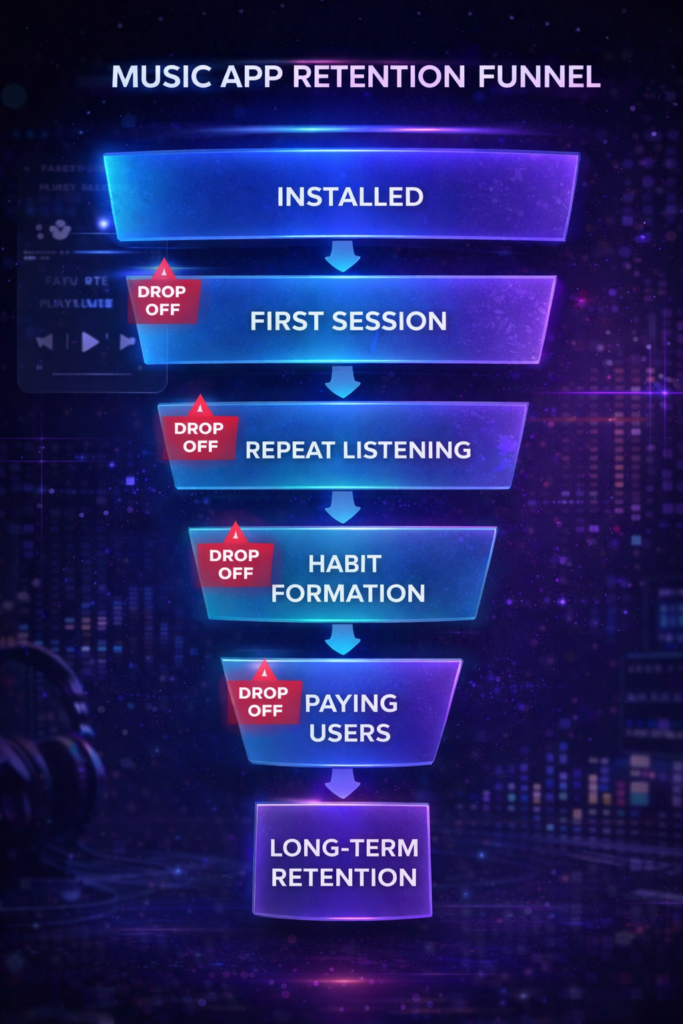
Music apps aren’t just driven by downloads. In reality, they are driven by behavior and economics. If you don’t understand these metrics, it’s impossible to evaluate whether your app is actually working or scaling. This is what investors, partners, and growth teams look at when deciding if a music app is viable.
DAU/MAU (Daily & Monthly Active Users)
These metrics measure how many users actively engage with your app. Specifically:
- DAU (Daily Active Users) measures how many people use your app each day
- MAU (Monthly Active Users) measures how many use it over a month
A strong ratio between DAU and MAU indicates consistent engagement instead of one-time usage.
Retention Rate
Retention shows how many users come back after their first experience. Common benchmarks include:
- Day 1 retention (initial interest)
- Day 7 retention (early engagement)
- Day 30 retention (long-term viability)
If users don’t return, growth becomes unsustainable.
Churn Rate
Churn is the percentage of users who stop using your app. High churn means:
- Weak product experience
- Poor engagement design
- Unmet user expectations
Reducing churn is just as important as acquiring users.
ARPU (Average Revenue Per User)
ARPU measures how much revenue each user generates on average. It helps you understand:
- How effective your monetization is
- Whether your business model is working
LTV (Lifetime Value)
LTV is the total revenue a user generates over their lifetime. This is one of the most important metrics because it determines how much you can afford to spend to acquire users.
CAC (Customer Acquisition Cost)
CAC is how much it costs to acquire a new user. This includes:
- Paid ads
- Influencer campaigns
- Marketing spend
Your business only works if lifetime value (LTV) is greater than your customer acquisition cost (CAC).
Why These Metrics Matter
These metrics connect your entire business:
Acquisition → Retention → Monetization → Revenue
A strong music app business plan doesn’t just list these metrics. Instead, it shows:
- How you improve them
- How they impact your growth
- How they drive long-term sustainability
Common Mistakes to Avoid
Formatting is rarely the reason music app business plans fail. Usually, they fail because they ignore how the business actually works. Here are the biggest mistakes you can make when writing your plan:
- Ignoring Licensing: If your app depends on music content, licensing is a requirement. Overlooking this can shut your app down before it scales.
- Weak Differentiation: Competing with platforms like Spotify without a clear advantage is a losing strategy. You need a defined niche or unique value.
- Poor Retention Design: If users don’t come back, your app doesn’t grow. Retention must be designed into the experience from the start. If you treat retention like an afterthought, you’ll struggle to keep users using your platform.
- Monetization Mismatch: Choosing the wrong model for your audience leads to low conversion and weak revenue. Monetization must align with user behavior.
- Overbuilding Too Early: Trying to launch with too many features increases costs and delays validation. Focus on a clear, simple MVP first.
Avoiding these mistakes is what separates apps that launch from apps that last.
[INSERT CTA BOX HERE]
FAQ: Music App Business Plans
A music app business plan should include your app concept, target audience, monetization strategy, licensing approach, user acquisition plan, retention strategy, and financial projections.
Music apps generate revenue through subscriptions, ads, in-app purchases, and creator monetization tools. Many use a hybrid model that combines free access with premium features.
If your app streams or distributes copyrighted music, licensing is typically required. Some apps avoid this by using user-generated content or partnering with artists directly.
Costs vary depending on complexity, but most music apps range from $30,000 to $150,000+, with additional costs for licensing, infrastructure, and marketing.
Successful music apps have strong retention, clear differentiation, effective monetization, and a scalable user acquisition strategy. Consistent engagement is key.
Final Thoughts
Building a music app is not just about creating features. Ultimately, it’s about designing a system that works. A system that attracts users, keeps them engaged, and turns that engagement into revenue over time.
Most founders focus on the idea. Very few focus on execution. That’s the difference.
If you take the time to think through your monetization, retention, licensing, and growth strategy before you build, you give your app a real chance to succeed in a highly competitive market.